
Education · Test & tag · April 2025
Test and tag at Sarah Redfern High School.
730 appliances checked. Seven failed items removed from service. A clear record of electrical equipment across the school.
Request a test and tag quote ↗01 — The project
Checking the equipment used throughout a school.
Masters Voice Technology completed a proactive test and tag program at Sarah Redfern High School between 15 and 30 April 2025. The service report records testing to AS/NZS 3760:2022 under work order 4856.
The 730-item equipment register covers appliances and leads across the school, including computers, monitors, power boards, extension leads, teaching equipment and appliances.
A result linked to each asset
The register identifies equipment by barcode, location, description, test date, test sequence and recorded outcome. Its 723 passing and seven failing entries reconcile with the completed service report.
This case study describes the April 2025 program; it is not a statement of every item’s condition today.
02 — Why test and tag matters
Why regular test and tag is important.
Electrical equipment can keep operating despite damaged insulation, worn plugs or a compromised protective earth. Inspection and testing help identify hazards before continued use exposes students, staff or contractors to electric shock or fire risks.
Find damage and electrical faults
Visual inspection checks accessible parts such as plugs, leads and enclosures. Suitable electrical tests help identify faults that appearance alone cannot establish.
Remove unsafe equipment
Finding a defect is only useful when action follows. For this project, the service report confirms that every failed item was removed from use and handed to school administration for disposal.
Support ongoing maintenance
Asset records make it easier to locate equipment, track outcomes and organise the next inspection. A tag records a check at a point in time; damage still needs to be reported between scheduled visits.
03 — Inspection, testing and records
An equipment register that supports action.
Identify and inspect
Match the appliance or lead to its asset record and inspect its condition. Testing must be appropriate to the equipment construction and manufacturer’s requirements.
Select the right test
The supplied register contains 631 TNT_CL1 and 99 TNT_CL2 sequence entries. Typical in-service checks include protective-earth continuity where applicable, and suitable insulation or leakage testing.
Label and record
Record the result against the asset and apply the appropriate identification. The school receives a service summary and an equipment register for maintenance follow-up.
Testing technology
Wavecom TnP Prime: test, print and scan.
The Wavecom TnP Prime brings portable appliance testing, thermal-transfer tag printing and barcode scanning together in one integrated system. Bluetooth connectivity with the WinPATS app connects equipment identification, test results and reporting.
Appliance testing
Supports Class I and Class II appliances, extension leads, leakage and RCD tests. The operator selects the appropriate test for the equipment and applicable requirements.
Printed identification
The integrated printer produces readable tags with equipment identification and test information, helping link each appliance to its maintenance record.
Barcode scanning
The scanner retrieves item information, results and due dates through WinPATS, supporting repeat visits and equipment tracking across a school.
For a program covering hundreds of items, connecting the test, tag and asset record helps make follow-up easier to manage.
Equipment capabilities: Wavecom TnP Prime product information.
04 — Recorded outcome
Seven failed items taken out of service.
The service report lists a hot plate, a flash unit, two power boards, two power supplies and a hot glue gun as failed. These were located in the canteen, teaching rooms and science facilities.
All seven were removed from service and given to Sarah Redfern High School administration for disposal. This completed action is central to the project: identified equipment was prevented from remaining in normal use.
The 723 passing entries and seven failures total 730 appliances. These figures describe the completed April 2025 testing program.
05 — Australian standards and NSW requirements
The rules behind a test and tag program.
NSW WHS legislation
The Work Health and Safety Act 2011 establishes workplace safety duties. The April 2025 work occurred under the WHS Regulation 2017; the current framework uses the WHS Regulation 2025.
AS/NZS 3760:2022
The project’s nominated standard covers in-service safety inspection and testing of electrical equipment and RCDs. It provides the technical framework for inspection, testing, tagging and intervals.
Code of practice
SafeWork NSW’s Managing electrical risks in the workplace code explains practical controls, competent testing and action on unsafe equipment. Construction and demolition activities have separate AS/NZS 3012 requirements.
What NSW workplaces need to do
Regular competent inspection and testing is required for plug-in equipment whose normal operating conditions are likely to cause damage or shorten its life—for example moisture, heat, vibration, mechanical damage, corrosive chemicals or dust.
Keep testing records until the next test, permanent removal or disposal. Records must identify the tester, test date, outcome and next test date; a tag can serve as the record. Unsafe equipment must be removed from use.
References: Current NSW legislation, SafeWork NSW inspection and testing requirements, and electrical risks code of practice.
06 — Testing frequency
How often does test and tag need to be completed?
There is no single annual rule for every appliance in every school. Set the interval according to the equipment’s use, environment, applicable standard, manufacturer’s guidance and school maintenance requirements.
| Equipment or environment | Inspection and testing approach |
|---|---|
| Higher-risk operating environments | As a general rule, test at least every 12 months; shorten the interval where the risk warrants it. |
| Workshop and manufacturing environments | The code gives at least every 6 months as an example of more frequent testing. |
| Commercial cleaning equipment | The code gives at least every 6 months as an example. |
| Hire equipment | Inspect at the start of each hire and test every 3 months. |
| Lower-risk office or classroom use | Assess the actual equipment and conditions. The higher-risk testing duty does not automatically impose an annual interval on every office appliance. |
| School construction or demolition work | Apply the relevant AS/NZS 3012 requirements for that activity. |
These are planning examples, not one school-wide schedule. Confirm the applicable standard and site requirements with a competent person. SafeWork NSW code, section 3.2.
Do not wait for a due date when damage is found
Report damaged or suspect equipment promptly and stop its use until it has been assessed. Following repair, the appropriate inspection and testing should be completed before return to service.
For schools, a useful schedule separates equipment exposed to workshop dust, moisture or frequent movement from equipment used in a stable office environment.
07 — Project photographs
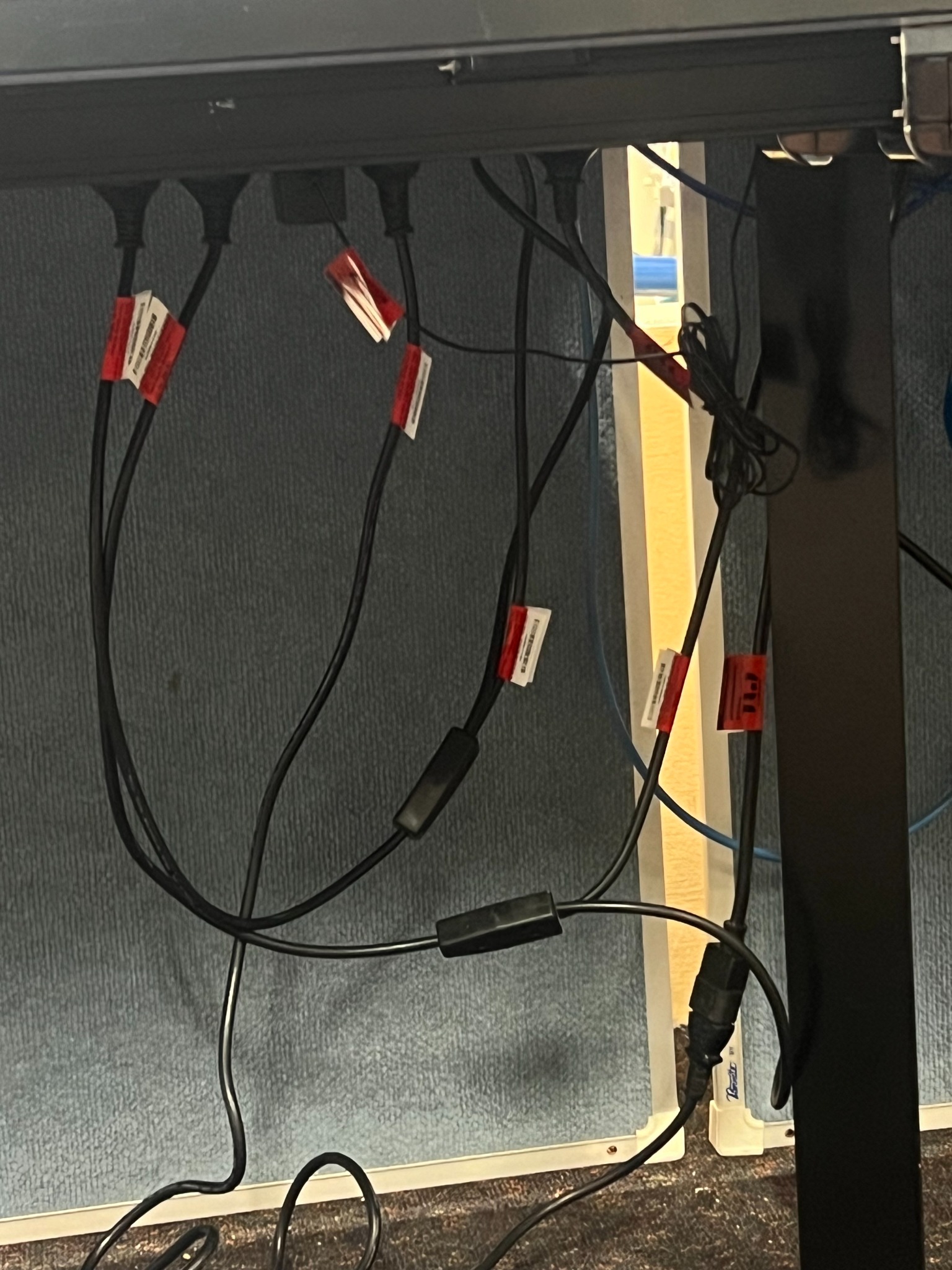
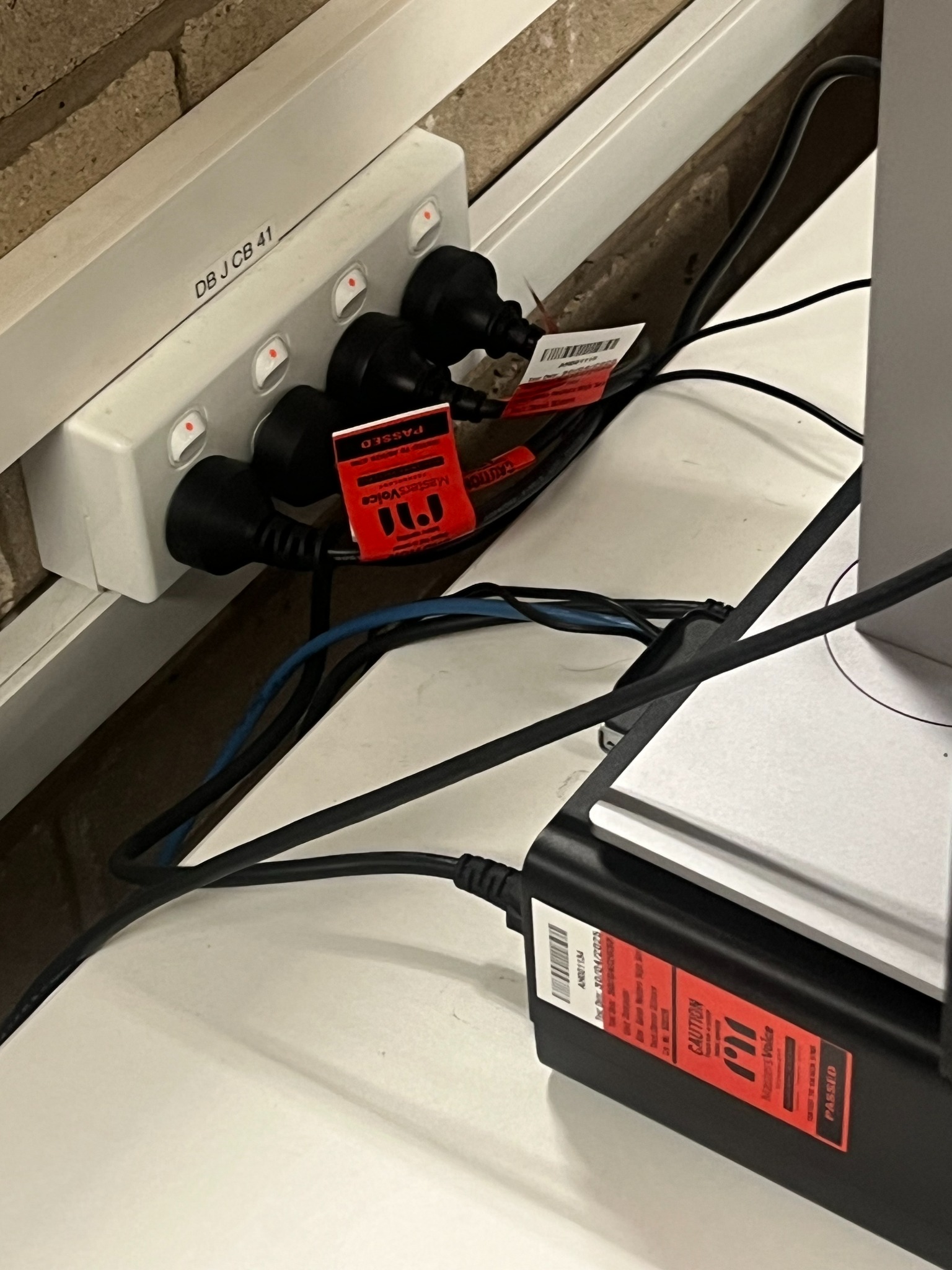
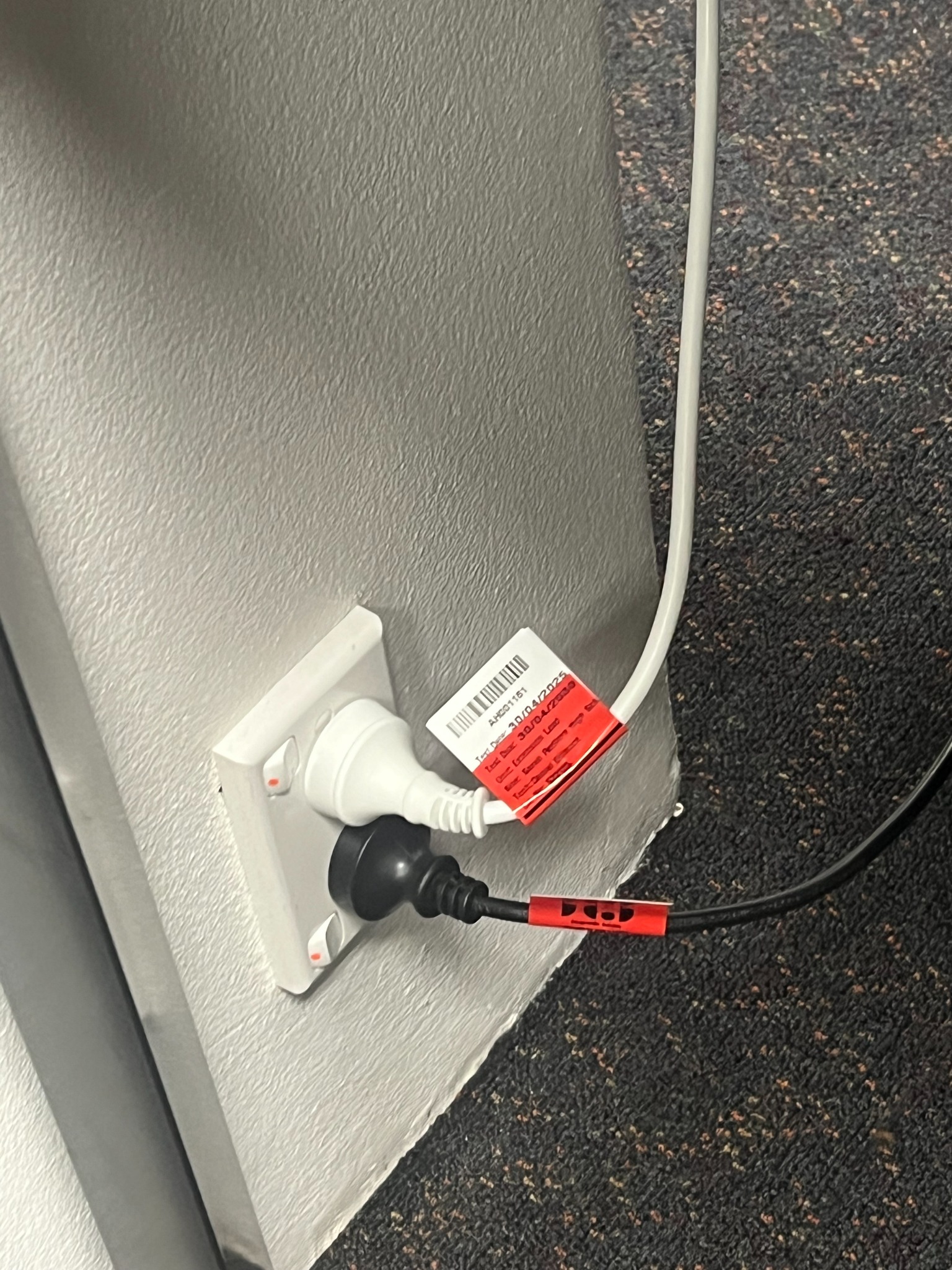
Equipment identification across the school.

08 — The outcome
A documented check, followed by practical action.
The completed program combined 730 equipment records with a clear outcome: 723 appliances passed and seven failed items were removed from service.
For the school, the register provides a basis for identifying equipment and managing future testing. For Masters Voice, the work demonstrates a practical approach to inspection, reporting and action on unsafe appliances.
Plan test and tag for your school or workplace.
Talk to Masters Voice about your equipment, operating environments and maintenance schedule.
To help scope a quote, share an approximate appliance count, the buildings or areas to be covered, any existing asset register or test records, and your preferred access times. Include any reporting requirements so the testing visit and records can be planned around school operations.
Discuss electrical test and tag as part of your maintenance program, with any repairs or replacement work scoped separately.
Request a test and tag quote ↗Explore electrical services and projects.
Find the right testing service, plan ongoing maintenance and see examples of our work in schools.