
Emergency communication · Sydney & NSW
Wireless emergency evacuation systems.
Clear signals.
Coordinated action.
Give authorised staff a practical way to trigger evacuation, lockdown and assistance messages across buildings and outdoor areas.
Masters Voice Technology plans, installs and configures emergency alert communication around your site, your people and your approved procedures.
Wireless activation · Recorded voice messages · Visual alert options
01 / Choose the right architecture
Wireless Evacuation Systems and Existing PA Integration
AARC-EVAC is one platform we have deployed for wireless emergency communication. The appropriate configuration depends on existing infrastructure, site layout and the procedures the system must support.
Connect separate buildings.
Radio-linked controllers can broadcast configured messages through local speakers. This can reduce the need for new inter-building signal cabling.
Consider for: campuses, dispersed facilities and sites without a suitable central PA.
Build on what is already there.
A compatible receiver/message player can feed an existing PA. Assess priority muting, audio coverage and backup power before choosing this approach. The AARC PA-input arrangement applies one evacuation message across the connected PA.
Consider for: facilities with a serviceable PA and an agreed emergency-message priority.
Include the spaces between.
Combine indoor notification with suitable outdoor controllers and local speakers. The manufacturer offers selected mains and solar-powered outdoor models; suitability depends on location and power requirements.
Consider for: open yards, walkways, recreation areas and campus extensions.
02 / Messages with a purpose
Different events.
Different instructions.
Select the functions your organisation needs, then agree who can activate them and what each message means. Available functions depend on the equipment and configuration.
Evacuation
Communicate the action set out in the approved evacuation procedure.
Lockdown
Use a distinct, agreed message for the site’s lockdown response.
Assistance
Consider first-aid or duress call points where a location-specific staff response is needed.
Drill & all-clear
Support planned practice and authorised end-of-event communication, where configured.
Alert meanings, escalation and cancellation should be documented and rehearsed. These functions do not replace contacting emergency services.
03 / Where it can help
Emergency Communication for Schools, Facilities and Venues
Schools & campuses
Consider staff activation points, separate teaching blocks and outdoor movement between lessons. Plan emergency communication alongside the school’s existing procedures.
For daily bells and paging, explore school PA systems ↗Warehouses & industrial sites
Review background noise, high roofs, loading areas and worker hearing protection. Assess audible messages and visual reinforcement together, under normal operating conditions.
Council & community facilities
Account for changing visitor groups, staff availability and separate buildings. Clear, agreed messages can help communicate the intended response to people unfamiliar with the venue.
Explore government and council AV ↗Venues & recreation grounds
Assess occupied indoor spaces and outdoor activity areas together. Existing sound infrastructure may be useful, but music priority, power resilience and intelligibility need review.
Explore general PA and sound systems ↗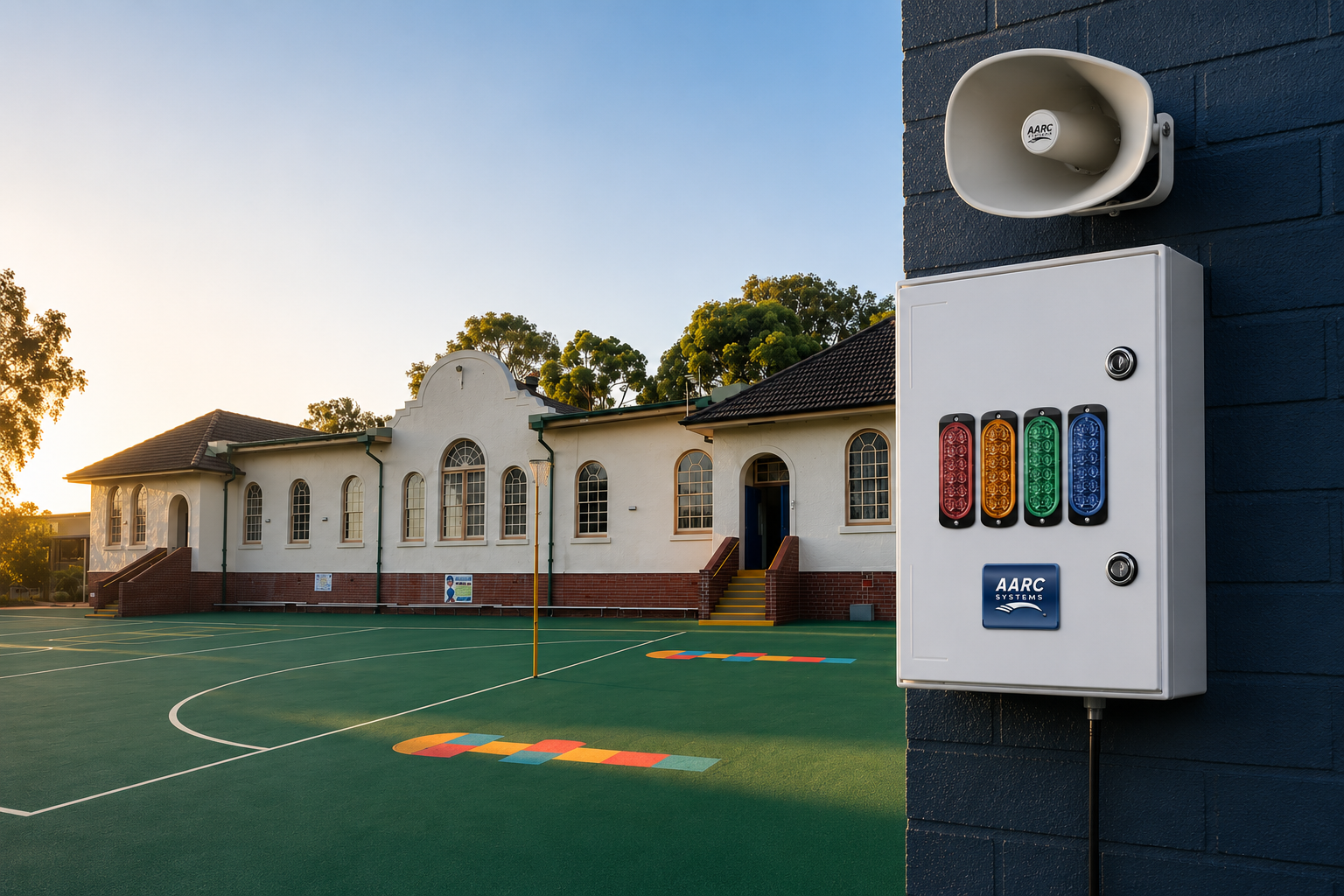
04 / A solution in practice
From a site requirement to a coordinated system.
At Merrylands East Public School, Masters Voice Technology delivered AARC-EVAC wireless activation with recorded instructions, outdoor horns and visual warning equipment.
Portable and fixed controls supported authorised staff operation. The project included configuration, testing and handover.
Explore the project05 / From survey to handover
Emergency Alert Assessment, Installation and Testing
Understand
Review the emergency plan, users, buildings, outdoor spaces and existing systems. Identify the required system classification.
Design
Agree activation locations, receiver placement, message selection, power arrangements and the areas to be assessed.
Verify
Test activation, audible communication and visual signalling in nominated areas. Record findings and address identified coverage gaps.
Maintain
Provide operating information and staff familiarisation. Agree ongoing checks and review the system when buildings or procedures change.
06 / Before you specify
Wireless Emergency Evacuation Installation FAQs
Does “wireless” mean there is no cabling?
No. It describes the radio link used for activation between compatible devices. Power and local speaker connections still need planning. AARC standalone controllers can include local battery backup; the selected model determines the arrangement.
Can different areas receive different instructions?
Selected networked AARC controller arrangements support location-specific messages. A PA-input interface has different constraints, including a single evacuation message over the connected PA. Define the zoning requirement before selecting equipment.
Can we keep our existing speakers?
Possibly. Assess the amplifier, speakers, priority override, cabling condition, intelligibility and backup power first. Compatibility with an emergency message source does not establish that the complete installation meets a statutory warning-system requirement.
What affects wireless range and outdoor coverage?
Buildings, construction materials, terrain, receiver position and the local radio environment affect the design. Radio reception and audible coverage are separate checks. A repeater may help a radio link; it does not make a voice message more intelligible.
Are visual beacons enough for accessible notification?
Beacons can supplement audible alerts, but accessibility depends on the people and spaces involved. Review sightlines, hearing needs and the organisation’s assisted-response procedures rather than relying on one type of notification.
How much does a system cost?
Cost depends on the number of buildings and notification areas, the existing PA, controller and speaker requirements, power, access and commissioning scope. A site assessment provides a basis for an itemised proposal.
Plan your next step
Make your emergency communication easier to act on.
Tell us what people need to hear, where they need to hear it and what you already have. We’ll help define the next step for your Sydney or NSW site.
Technical references: manufacturer capabilities are model-dependent. Reviewed October 2026.
AARC controllersPA interfaceRemote controlsEquipment optionsEmergency planning guidance