
Education · Electrical maintenance · August 2026
RCD testing at Robert Townson High School.
Checking the safety switches behind a school’s daily operations, with measured results and clear priorities for follow-up.
Request an RCD testing quote ↗01 — The project
Making electrical protection visible.
Masters Voice Technology carried out a proactive electrical testing program at Robert Townson High School in August 2026. The work combined fixed-RCD push-button checks, operating-time tests and circuit-level reporting across the school’s distribution boards.
Electrical protection can be easy to overlook when facilities appear to be operating normally. An RCD, commonly called a safety switch, is designed to disconnect electricity when it detects harmful leakage to earth. Its presence alone does not demonstrate that it will operate effectively when needed.
Across a school campus, useful reporting also means knowing which circuit was tested, where it is located and which findings require attention.
02 — Why RCD testing matters
Why regular RCD testing is important.
An RCD is designed to rapidly disconnect the supply when it detects residual current, helping reduce the risk of serious electric shock. A circuit can still supply power even when its safety switch is not operating correctly. Working lights and equipment therefore do not confirm that the RCD will respond to a fault.
Help protect people
In schools, students, staff and contractors use electrical equipment every day. Testing checks an important protective measure in classrooms, workshops, kitchens and other learning and work areas.
Check actual performance
Regular checks can reveal a device that fails to operate correctly. Instrument testing measures its response so results can be assessed against the appropriate criteria.
Turn findings into action
Recorded results help facilities teams locate affected circuits, investigate failures and plan corrective work. At Robert Townson High School, the testing program identified nine failed circuit records requiring follow-up.
RCDs provide additional protection; they do not replace safe equipment, sound wiring or other electrical safety measures. Testing and timely action on defects belong together.
Read more: SafeWork NSW — Managing electrical risks in the workplace.
03 — Scope of work
Test the device. Record the result. Identify the follow-up.
RCD operation
Push-button checks and instrument testing of fixed-RCD operating times, recorded against circuit and distribution-board references.
Traceable reporting
Detailed test measurements and a separate failed-circuit register, supported by distribution-board photographs and test labels.
Emergency-stop checks
Separate testing in technical learning areas, science facilities and the school hall. The service report records all 15 emergency stops passing.
The detailed report lists Fluke 1662, 1663 and 1664 FC installation testers. Fluke TruTest records provide the accompanying circuit results and failed-circuit summary.
04 — Recorded findings
A defined list for maintenance action.
The service report’s RCD testing summary records 633 items: 624 passed and nine failed. The failed-circuit register identifies nine circuits across four distribution-board locations.
From finding to follow-up
The register records the failures as open and requiring rectification. The specific cause of each failed result needs to be confirmed from its measurement details before corrective work is determined.
These figures describe the testing outcome. They do not establish that subsequent repairs and retesting have been completed or certify the whole installation.
05 — Australian and NSW requirements
RCD testing is part of a workplace’s electrical safety duties.
In NSW, the legal framework is the Work Health and Safety Act 2011 and Work Health and Safety Regulation 2025. Australian Standards support the technical requirements for installation and testing; they are not interchangeable with workplace legislation. See SafeWork NSW’s current legislation.
Provide appropriate protection
RCD protection is required for specified higher-risk uses of socket-connected equipment, including conditions involving moisture, heat, vibration, mechanical damage, chemicals or dust, and certain moving equipment. The installation’s protection requirements also need to be assessed under the Wiring Rules.
Test regularly and competently
Those managing a workplace must ensure its RCDs are regularly tested by a competent person to confirm effective operation. A test button checks basic operation; instrument testing provides measured performance.
Keep records and act on defects
SafeWork NSW says test records, other than push-button records, must be retained until the next test or disposal. Faulty RCDs must be taken out of service and replaced as soon as possible; electrical work requires appropriately licensed workers.
Sources: SafeWork NSW RCD guidance and Managing electrical risks in the workplace code of practice.
How often should school RCDs be tested?
Set a documented schedule using the operating environment, applicable standard, manufacturer’s instructions and school maintenance requirements. Distinguish push-button checks from instrument tests. An annual date in one report does not establish a universal legal interval for every RCD or school area.
06 — Standards and their roles
Installation rules and maintenance testing serve different purposes.
Wiring Rules
Addresses electrical installation requirements, including applicable RCD protection. Installing a device and maintaining its performance are separate responsibilities.
In-service inspection and testing
Provides guidance for in-service safety inspection and testing, including RCD testing intervals for different operating environments.
RCD approval and test specifications
Addresses residual current device approval and testing specifications. The project service report cites AS/NZS 3190:2016.
These standards’ roles are discussed in SafeWork NSW’s electrical risks code. Confirm applicable editions, amendments and contractual requirements when specifying a program. A device approval standard alone does not establish a school’s complete maintenance schedule.
07 — Fluke testers and the recorded tests
From a safety-switch check to a measured result.
The detailed project report lists Fluke 1662, Fluke 1663 and Fluke 1664 FC installation testers. These instruments support RCD trip-time and ramp testing, automatic RCD test sequences and stored measurements. The 1664 FC also supports Fluke Connect wireless connectivity; the report does not establish that wireless transfer was used on this project.
Fluke TruTest supports organising results against site, distribution-board and circuit references. That traceability helps turn measurements into a useful maintenance record. Fluke 1662 / 1663 / 1664 FC user manual.
Identify and prepare
A competent tester plans the interruption, identifies the circuit and RCD, and checks the instrument’s suitability and calibration status. Device type, residual-current rating and test waveform determine the appropriate settings and acceptance criteria.
Check and measure
The service report records push-button and operating-time checks. The detailed report includes half-current, rated-current and five-times-current tests at both 0° and 180°.
Record and follow up
Measurements are linked to circuit references. Failed results require investigation, appropriate corrective work and documented verification. A failed circuit result must be reviewed before attributing it to a defective RCD.
| Test | Purpose |
|---|---|
| Push-button check | Exercises the built-in test function; it does not measure trip time. |
| ½ × rated residual current | Checks non-operation at the selected lower test current. A “>310 ms” entry in the sample records no trip within that test window. |
| 1 × rated residual current | Records operating time at the selected rated residual test current. |
| 5 × rated residual current | Records operating time at a higher test-current setting, where appropriate for the device. |
| 0° and 180° | Repeats testing at opposite waveform starting points to check response under both conditions. |
Ramp testing progressively increases residual current to measure the tripping level. It is a tester capability, but no ramp result is claimed for the sample circuit. Tests and pass limits must suit the particular RCD; the six recorded measurements are not a universal checklist for every RCD type.
08 — Project photographs
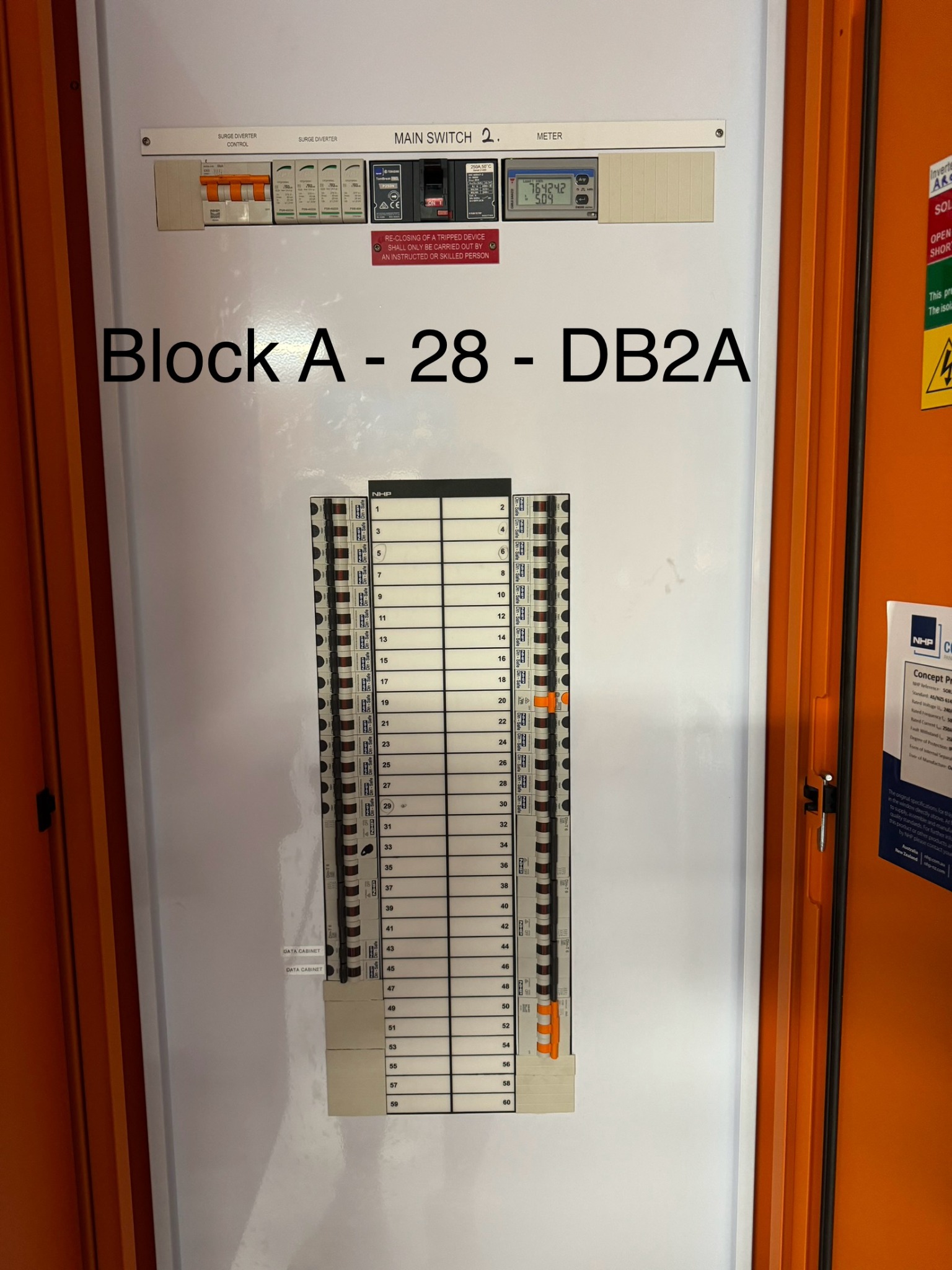
Distribution boards documented on site.
Board references and test labels help connect the physical installation with the maintenance records.

Testing records in Fluke TruTest.
From individual readings to distribution-board summaries, these screenshots show how results are recorded and reviewed.


Select either image to view the testing record at full size.
09 — Download a sample report
See the measurements behind the reporting.
This sample uses actual readings from A Block — DB2 — AR0006 / 27, circuit C_1. It is a selected extract for this case study, rather than a new test certificate.
Download sample RCD report (PDF) ↓Sample: 30 mA RCD
| Test | 0° | 180° |
|---|---|---|
| ½ × | >310 ms | >310 ms |
| 1 × | 28.4 ms | 18.6 ms |
| 5 × | 8.9 ms | 18.4 ms |
10 — Our school testing portfolio
RCD testing across 28 NSW public schools.
Robert Townson High School forms part of the 28-school portfolio for which Masters Voice currently provides RCD testing. Our coverage includes primary and secondary schools, with testing records organised by school, distribution board and circuit.
Schools we currently support
- Abbotsford Public School
- Annandale North Public School
- Annandale Public School
- Blairmount Public School
- Bridge Road Public School
- Campbellfield Public School
- Claymore Public School
- Dobroyd Point Public School
- Drummoyne Public School
- Eagle Vale High School
- Five Dock Public School
- Forest Lodge Public School
- Ingleburn High School
- Ingleburn Public School
- Kearns Public School
- Leumeah High School
- Leumeah Public School
- Macquarie Fields High School
- Macquarie Fields Public School
- Minto Public School
- Robert Townson High School
- Robert Townson Public School
- Russell Lea Public School
- Sackville Street Public School
- Sarah Redfern Public School
- Sarah Redfern High School
- St Andrews Public School
- The Grange Public School
11 — The outcome
Evidence to support the next maintenance decision.
The program delivered a testing summary, supporting circuit measurements and an actionable failed-circuit register, alongside successful results for all 15 emergency stops included in the service report.
For the facilities team, this creates a documented basis for locating defects, planning corrective work and maintaining a record for future testing.
Plan RCD testing for your school or facility.
Talk to Masters Voice about your site, testing schedule and reporting requirements.
To help scope a quote, share your distribution-board or RCD list, previous test reports, reporting requirements and preferred site access times. Identify operating hours and suitable interruption windows so testing can be coordinated with the facilities team.
Discuss RCD testing within an electrical preventative maintenance program, with defect rectification scoped separately from the testing visit.
Request an RCD testing quote ↗Explore electrical services and projects.
Find the right testing service, plan ongoing maintenance and see examples of our work in schools.