01
See availability
Colour-coded displays and status lighting can make room availability visible while users are still walking down the corridor.

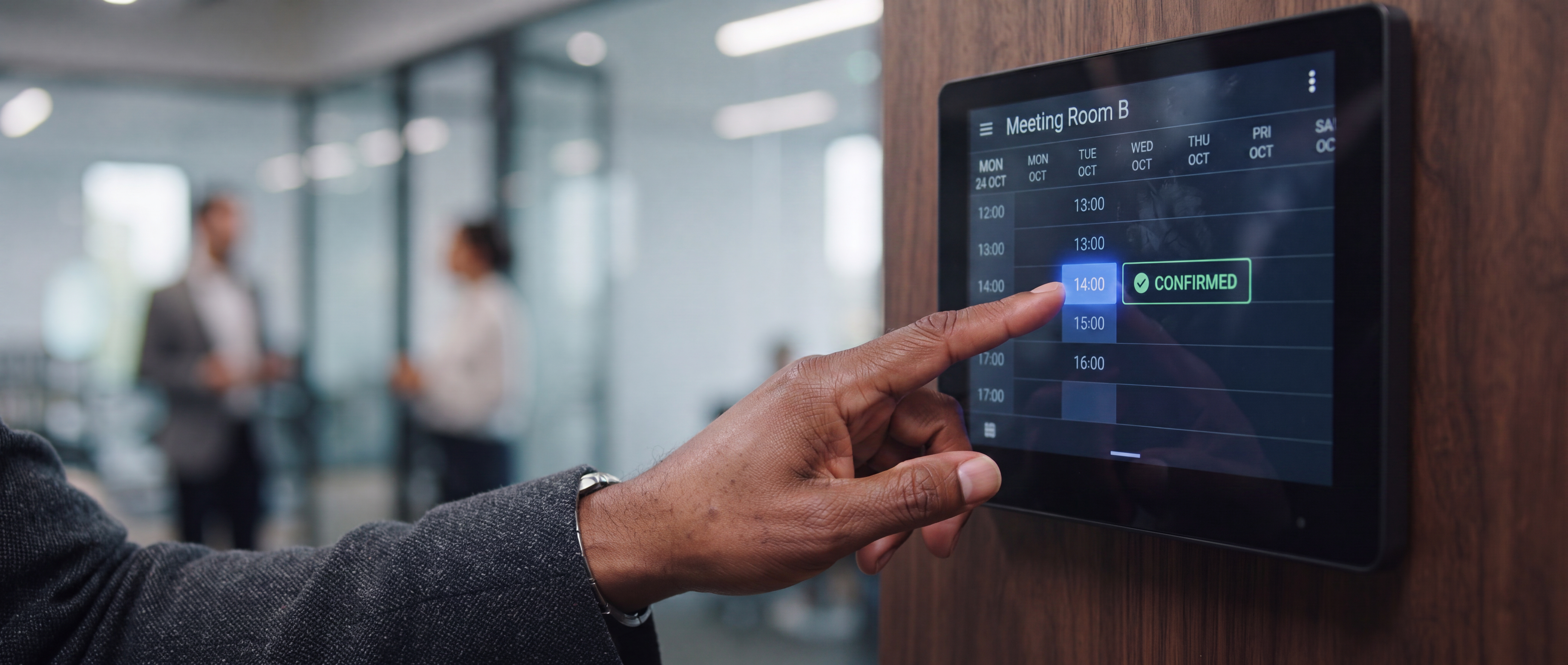
A small screen outside the door can solve a surprisingly large workplace problem.

Finding an available meeting room should not require walking the office checking doors. Compare the leading room scheduling panels and learn how modern room booking displays can improve availability, reservations, check-in and workplace utilisation.
A scheduling panel puts the room calendar where people actually need it — outside the room. Staff can understand availability, reserve spaces and identify upcoming meetings without interrupting the people already using the space.
Colour-coded displays and status lighting can make room availability visible while users are still walking down the corridor.
Supported scheduling platforms allow an available room to be reserved without returning to Outlook or another workplace application.
Check-in, occupancy and supported auto-release workflows can return no-show bookings to the available room pool.
Staff do not need to know which team normally uses a room. The room itself communicates whether it is available.
Booking and occupancy information can help facilities teams understand which room sizes and spaces are genuinely being used.
This distinction is important. Microsoft Teams Panels is a room-scheduling experience and platform. Compatible manufacturers supply the physical touchscreen devices that run the scheduling application.
Products such as the Logitech Tap Scheduler, Crestron TSS, Neat Pad and Yealink RoomPanel provide the hardware layer.
Microsoft specifically allows certified Teams Panel hardware outside the room to differ from the equipment installed inside the room. That gives organisations greater flexibility when standardising a workplace.
Which scheduling ecosystem should the organisation operate, and which hardware is the best way to deliver it? That is a more useful starting point than simply asking which touchscreen looks best.
There is no universal winner. The correct product depends heavily on the organisation's calendar, collaboration platform, room standard, management strategy and wider workplace technology.
| Product | Strongest Fit | Key Advantage | Platform Flexibility | Consider |
|---|---|---|---|---|
| Microsoft Teams Panels | Microsoft 365 / Teams workplaces | Deep Teams and Outlook workflow | Runs on certified hardware from several manufacturers | Microsoft licensing and room resource configuration |
| Logitech Tap Scheduler | Standardised or mixed workplace estates | 10.1-inch display and broad scheduling-platform support | Excellent | Scheduling device remains separate from room AV system |
| Crestron TSS-770 / TSS-770-T | Enterprise AV and integrated workplaces | Scheduling, management and integration options | Excellent | Particularly valuable in broader Crestron environments |
| Neat Pad | Teams, Zoom and Neat environments | Minimal hardware that can be controller or scheduler | Good | Strongest fit within a Neat collaboration estate |
| Yealink RoomPanel E2 / Plus E2 | Teams / Zoom standardised workplaces | Highly visible status indication | Good | Confirm platform and current certification |
Microsoft Teams Panels are designed to sit outside bookable meeting spaces and display information from Teams and Outlook calendars.
Users can see the room name, current meeting, availability and upcoming bookings, and can reserve an available room from the panel.
One major advantage is that Microsoft defines the scheduling experience while certified manufacturers provide the physical panel.
Current Microsoft licensing distinguishes between Teams Rooms and shared-space scenarios. Confirm the correct licence for the actual room type before the panel rollout is specified.
Supported Teams Panels can now display future room availability and allow a future meeting reservation to be created directly from the panel.
Check-in can require the meeting user to confirm that the reserved room is genuinely being used.
In supported circumstances, an unused booking can be released if nobody checks in within the configured time after the meeting starts.
Tap Scheduler is a purpose-built 10.1-inch scheduling panel designed for installation outside meeting rooms, with mounting approaches for walls, glass and mullions.
One of its strongest advantages is the breadth of supported scheduling platforms.
Crestron's TSS family uses purpose-built enterprise touchscreens with Ethernet, PoE connectivity and dedicated scheduling functions.
The TSS-770-T specifically supports the Microsoft Teams Panels experience while also supporting additional scheduling applications.
Crestron becomes especially relevant when scheduling forms part of a wider workplace system involving room control, conferencing, occupancy, lighting, blinds or enterprise device management.
Neat Pad can operate as an in-room meeting controller or as an external room scheduling display.
Its simple design and Power over Ethernet installation make it particularly suitable where Neat hardware already forms part of the workplace room standard.
Neat currently supports Pad as a Zoom Rooms scheduling display, a Microsoft Teams panel and with supported third-party scheduling providers for Google Meet spaces.
Yealink's current RoomPanel E2 is a purpose-built meeting-room scheduling panel supporting platforms including Microsoft Teams and Zoom Rooms.
Android 13, full-RGB bilateral status lighting, Wi-Fi, Bluetooth and PoE/DC installation make it a practical corridor-side device.
It becomes especially logical where the room estate already uses Yealink conferencing hardware and the organisation wants consistent management, mounting and hardware support.
Start with Teams Panels as the software experience, then select current certified hardware that suits mounting and management requirements.
Tap Scheduler aligns naturally with Rally Bar and Tap deployments while retaining broad scheduling platform flexibility.
TSS becomes particularly attractive where scheduling interacts with occupancy, room control or wider Crestron infrastructure.
Neat Pad offers a consistent controller and scheduling architecture without unnecessary complexity.
RoomPanel E2 is a natural extension where Yealink already forms part of the conferencing standard.
A premium touchscreen cannot fix an incorrectly configured calendar environment. The long-term user experience is governed by the entire workflow.
Which calendar platform is authoritative?
Are the rooms Microsoft Teams Rooms, Zoom Rooms, BYOD spaces or mixed?
Does the organisation need ad-hoc booking directly from the scheduling panel?
Is future booking from the room panel required?
Will staff need to check in to confirm that a reserved room is actually being used?
Should unused reservations automatically return to the available room pool?
Is occupancy sensing or workplace utilisation data required?
Who owns the system after handover — AV, IT or facilities?
The same principle applies to the technology inside the meeting space. Continue with How to Design a Meeting Room That Actually Works for cameras, audio, displays, connectivity and control, or compare Microsoft Teams Rooms vs BYOD before standardising the room platform.
Scheduling can be particularly valuable outside smaller BYOD rooms. A four-person room may contain only a display, compact video bar and USB connection, while still having its own Microsoft 365 room resource and scheduling panel.
The result is a consistent workplace experience: every bookable room can behave like a managed workplace resource even when the AV technology inside the rooms differs.
Keep that separate from the room-scheduling decision. Our Teams Rooms vs BYOD comparison explains which room operating model may be appropriate.
Purpose-built room scheduling panels generally offer advantages over consumer tablets in mounting, power, status indication and enterprise device management.
A good panel cannot compensate for an unsupported scheduling application or incorrect platform choice.
Boardroom, Board Room, Level 3 Boardroom and BR-301 should not all describe the same space in different systems.
Microsoft and other platforms may require licences that depend on how the room and panel are being used.
Permanent wall devices can benefit from predictable wired connectivity and PoE where the product supports it.
Ghost bookings can continue consuming space unless check-in and release rules are deliberately configured.
Twenty scheduling panels are twenty connected devices that need updates, monitoring, credentials and eventual replacement.
A good panel cannot compensate for an unsupported scheduling application or incorrect platform choice.
Boardroom, Board Room, Level 3 Boardroom and BR-301 should not all describe the same space in different systems.
Microsoft and other platforms may require licences that depend on how the room and panel are being used.
Permanent wall devices can benefit from predictable wired connectivity and PoE where the product supports it.
Ghost bookings can continue consuming space unless check-in and release rules are deliberately configured.
Twenty scheduling panels are twenty connected devices that need updates, monitoring, credentials and eventual replacement.
These related Masters Voice guides cover adjacent search intents without duplicating the room-scheduling topic.
Decide whether the room should operate as a dedicated conferencing system or through the user's laptop.
Compare room platforms →Plan cameras, audio, displays, connectivity and control around the room and its users.
Read the design guide →Review planning budgets for BYOD rooms, Teams Rooms, boardrooms and room-booking panels.
Review room costs →Explore dedicated Teams Room systems, certified hardware and one-touch collaboration.
Explore Teams Rooms →Explore Logitech room systems, Rally Bar, Tap controllers and scheduling technology.
Explore Logitech →Explore enterprise room control, scheduling, conferencing and connected workplace systems.
Explore Crestron →Scheduling applications, firmware, certification and licensing can change. Use the manufacturer's current documentation when preparing the final project specification.
Teams Panels planning, management and features.
Microsoft Learn ↗Tap Scheduler compatibility information.
Logitech ↗TSS Teams Panels scheduling documentation.
Crestron ↗Neat Pad controller and scheduling applications.
Neat ↗Current RoomPanel E2 information.
Yealink ↗For Microsoft-standardised organisations, Teams Panels may provide the most natural scheduling experience. Logitech offers strong platform flexibility. Crestron suits deeper enterprise integration, while Neat and Yealink can provide consistent extensions to their respective collaboration environments.
The objective remains the same: people should know whether a room is available, book it quickly, find the correct meeting and get on with their work.