Audio Visual Consultant
August 3, 2026
arrow up right

What Does an Audio Visual Consultant Do? Sydney Guide

Executive summary

Commercial AV success starts long before equipment is ordered. It starts with the right questions.

The most successful commercial audio visual projects rarely begin by choosing a display, camera or microphone. They begin by understanding how people work, how each room will be used, which systems must connect and how the organisation expects the technology to be operated and supported.

A professional audio visual consultant turns those business and operational requirements into a coordinated technical plan. This creates a clear pathway for architects, builders, IT teams, electricians, communications contractors, AV integrators and facility managers to work toward the same result.

For Sydney commercial projects, early AV consultancy can reduce unclear tender assumptions, prevent expensive construction variations, improve equipment comparisons and establish how the completed system will be commissioned, documented and accepted.

The central consultancy principle

Define the required outcome before the project starts comparing products.

Commercial AV consultancy should establish who will use the system, what they must be able to achieve, which spaces and interfaces are included, what infrastructure is required and how successful completion will be verified. Equipment selection should follow those decisions—not replace them.

01 — DEFINE

Translate business needs into clear AV requirements.

Document room purpose, user groups, required workflows, collaboration platforms, accessibility, security and operational priorities before technical decisions are finalised.

02 — COORDINATE

Resolve infrastructure requirements before construction.

Coordinate displays, cameras, microphones, equipment racks, electrical power, data cabling, network services, furniture, lighting, acoustics and structural support.

03 — DOCUMENT

Give contractors enough information to price the same outcome.

Prepare AV scopes of works, system schematics, plans, equipment schedules, technical specifications, tender schedules and controlled substitution requirements.

04 — VERIFY

Confirm the delivered system performs as intended.

Review installation quality, test complete user workflows, confirm documentation and training, close defects and establish ongoing ownership for support and lifecycle management.

Project takeaway: an AV consultant creates the roadmap that connects initial business requirements with commercial AV design, procurement, construction, commissioning and long-term support.

Commercial AV consultancy · Sydney project guide

What Does an Audio Visual Consultant Do? A Practical Guide for Sydney Commercial Projects.

Learn when to engage an audio visual consultant, what an AV design brief should include, which drawings and tender documents a project requires, how consultancy differs from integration and how design intent should be verified before handover.

For: Facilities, IT, architects, builders and project managers Region: Sydney and New South Wales Updated: August 2026
Discover Users, rooms and outcomes
Document Briefs, drawings and scope
Coordinate AV, power, data and construction
Verify Design intent and performance
01 — The consultant’s role

An AV consultant defines requirements, removes ambiguity and protects the project from avoidable redesign.

Commercial audio visual consultancy sits between business requirements, architectural design, technical engineering, procurement and system acceptance. Its value is the creation of clear decisions and documentation before site work becomes expensive to change.

PROGRAMMING

Understand what the organisation needs

Identify stakeholders, room functions, participant numbers, collaboration platforms, presentation workflows, support expectations, security requirements and future growth.

ASSESSMENT

Review rooms and existing infrastructure

Assess dimensions, sightlines, ceiling conditions, acoustics, lighting, existing equipment, rack locations, cabling routes, electrical supply and network readiness.

CONCEPT DESIGN

Convert requirements into an architecture

Establish room types, system topology, collaboration approach, audio strategy, video distribution, control requirements and equipment-room concepts.

DOCUMENTATION

Create information that others can price and build

Prepare scopes, performance requirements, schematics, layouts, schedules, rack information and coordination notes for tendering and construction.

PROCUREMENT

Support fair technical comparison

Clarify the scope, answer tender questions, assess proposed substitutions and review whether submissions meet the required performance and support outcomes.

VERIFICATION

Confirm design intent before acceptance

Review installation, documentation and system performance against agreed criteria, then identify defects and unresolved requirements before final handover.

02 — When to engage

Engage AV consultancy while layouts, budgets and infrastructure can still be changed.

The greatest value is normally created before ceilings close, furniture is ordered, network switches are selected or electrical and data outlets are fixed in place.

NEW BUILD

Commercial buildings and public facilities

Engage an audio visual consultant during concept or schematic design so room dimensions, cable pathways, ceiling services, control locations, equipment rooms and mounting requirements can be coordinated before construction progresses.

WORKPLACE FIT-OUT

Meeting rooms and collaboration spaces

Commercial AV consultancy can help define room types, Microsoft Teams Rooms or BYOD strategy, display requirements, furniture interfaces, acoustic considerations, management responsibilities and ongoing support expectations.

COMPLEX UPGRADE

Existing rooms with connected systems

Review which assets remain reliable and supportable, which infrastructure can be reused and how new equipment will integrate with existing networks, room controls, software platforms and building services.

TENDER PROJECT

Competitive commercial procurement

A clear AV design brief, scope of works and set of performance criteria allows contractors to price the same required outcome instead of submitting product packages built around different assumptions.

MULTI-SITE PROGRAM

Repeatable rooms across several locations

Consultancy can establish approved room profiles, common user workflows, infrastructure rules, controlled design exceptions, deployment templates and standard commissioning requirements.

DESIGN REVIEW

Technical review before procurement

An experienced AV design consultant can identify missing scope, coordination conflicts, unsupported products, incomplete infrastructure requirements and acceptance risks before the project commits to equipment.

Timing matters

Early AV consultancy prevents technology requirements from becoming late construction variations.

Displays, cameras, microphones, loudspeakers and room-control systems depend on correctly positioned power, communications outlets, cable pathways, structural support, equipment ventilation, furniture and network capacity. These requirements are easier and less expensive to coordinate before construction is substantially complete.

01 — The consultant’s role

An AV consultant defines requirements, removes ambiguity and protects the project from avoidable redesign.

Commercial audio visual consultancy sits between business requirements, architectural design, technical engineering, procurement and system acceptance. Its value is the creation of clear decisions and documentation before site work becomes expensive to change.

PROGRAMMING

Understand what the organisation needs

Identify stakeholders, room functions, participant numbers, collaboration platforms, presentation workflows, support expectations, security requirements and future growth.

ASSESSMENT

Review rooms and existing infrastructure

Assess dimensions, sightlines, ceiling conditions, acoustics, lighting, existing equipment, rack locations, cabling routes, electrical supply and network readiness.

CONCEPT DESIGN

Convert requirements into an architecture

Establish room types, system topology, collaboration approach, audio strategy, video distribution, control requirements and equipment-room concepts.

DOCUMENTATION

Create information that others can price and build

Prepare scopes, performance requirements, schematics, layouts, schedules, rack information and coordination notes for tendering and construction.

PROCUREMENT

Support fair technical comparison

Clarify the scope, answer tender questions, assess proposed substitutions and review whether submissions meet the required performance and support outcomes.

VERIFICATION

Confirm design intent before acceptance

Review installation, documentation and system performance against agreed criteria, then identify defects and unresolved requirements before final handover.

04 — Consultant versus integrator

Consultancy defines and documents the required outcome. Integration builds and supports the system.

The roles can be separated or delivered through one accountable design-and-construct team. The important issue is that responsibilities, commercial interests, review processes and acceptance criteria are clear.

AV CONSULTANT

Advisory, design and procurement role

  • Stakeholder discovery and needs analysis
  • Existing-system assessment
  • Concept and detailed design
  • Performance requirements and specifications
  • Tender documentation and technical evaluation
  • Design review and acceptance verification
AV INTEGRATOR

Delivery, programming and support role

  • Equipment supply and logistics
  • Installation and cable termination
  • Rack fabrication and system configuration
  • DSP, control and user-interface programming
  • Testing, training and handover
  • Warranty, maintenance and managed support
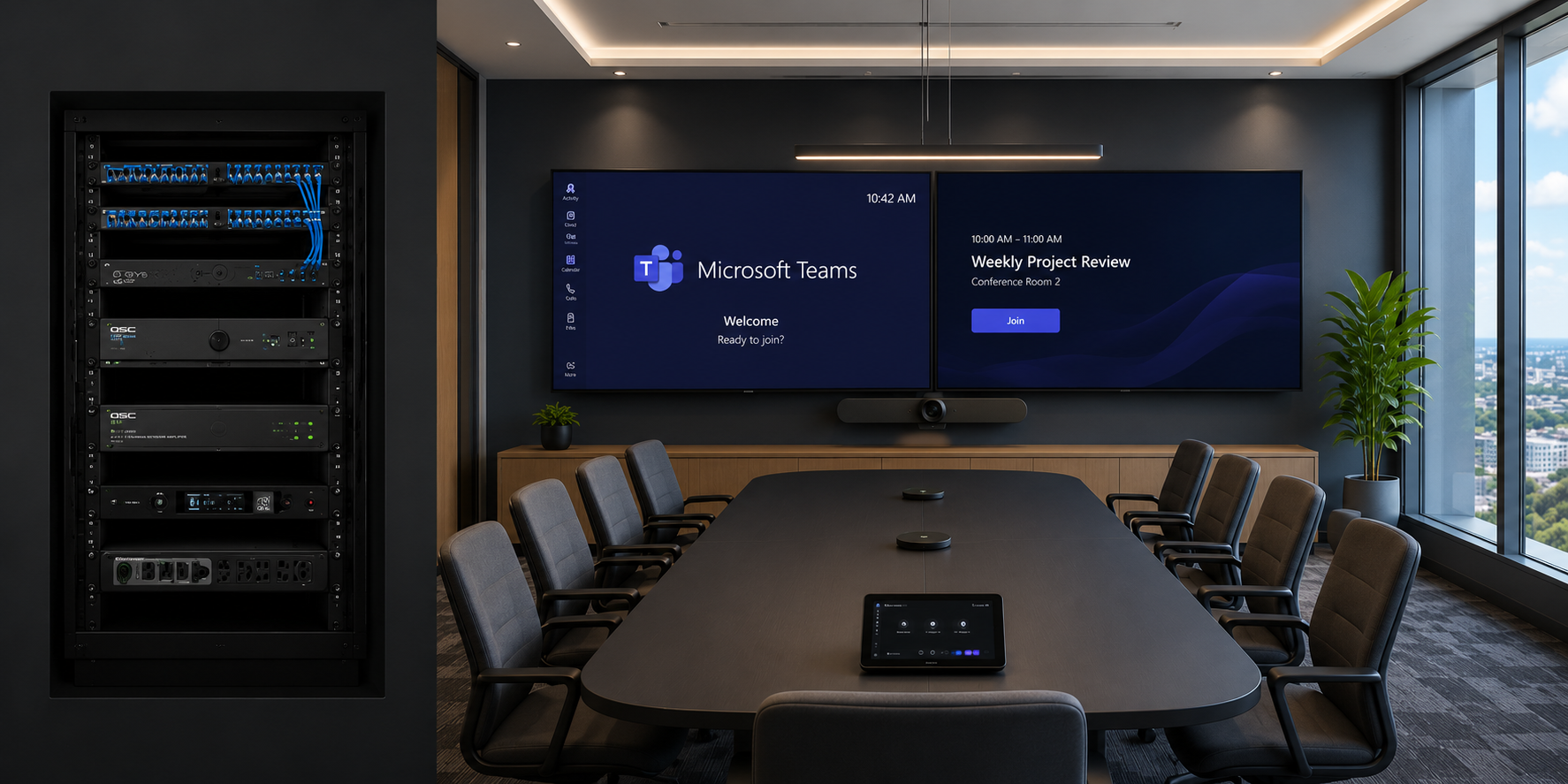
Commercial AV design and integration for a professional meeting room
Design-and-construct delivery

One team can provide consultancy and delivery when the governance is transparent.

A design-and-construct model can shorten communication paths and give the design team direct access to installation, programming, electrical, communications and support expertise.

The client should still receive documented requirements, a defined scope, transparent assumptions, controlled substitutions and clear acceptance testing.

05 — Procurement models

Select the procurement model around risk, complexity, timing and the client’s internal capability.

MODEL 01

Independent consultant-led design

The consultant develops the design and tender package before contractors compete to deliver it.

  • Useful for formal competitive tenders
  • Clear separation between design and supply
  • Strong client-side technical representation
  • Requires sufficiently complete documentation
MODEL 02

Design-and-construct AV delivery

One AV partner develops the design and then supplies, installs, programs and commissions the system.

  • Faster technical feedback loops
  • Single accountable delivery team
  • Practical access to installation expertise
  • Needs transparent scope and acceptance criteria
MODEL 03

Performance-based contractor design

The client or consultant defines performance requirements and the contractor completes the detailed technical solution.

  • Allows controlled product flexibility
  • Can suit specialised contractor expertise
  • Requires measurable performance requirements
  • Needs careful technical review of submissions

No model is automatically superior. A consultant-led tender may suit a major public procurement, while a design-and-construct approach may be more efficient for a workplace fit-out or technology refresh. The documentation must clearly identify which party owns design decisions, coordination, substitutions, programming, testing and ongoing support.

06 — Multidisciplinary coordination

Commercial AV systems depend on decisions made by architects, builders, electricians, data teams and IT.

Many AV problems originate outside the equipment list: unsuitable furniture, missing cable pathways, insufficient PoE capacity, incorrect wall backing, poor acoustics, competing ceiling services or unclear security responsibility.

ARCHITECTURE

Room geometry and equipment integration

  • Display walls and mounting structure
  • Camera sightlines
  • Ceiling coordination
  • Accessible control locations
FURNITURE

User positions and connection points

  • Participant seating and camera views
  • Table boxes and cable routes
  • Microphone positions
  • Flexible room configurations
ELECTRICAL

Power and equipment readiness

  • Dedicated circuits and outlets
  • Display and projector power
  • Rack power and cooling
  • Isolation and access requirements
COMMUNICATIONS

Cabling pathways and network outlets

  • Cat6 and fibre pathways
  • Patch panels and rack capacity
  • Floor boxes and consolidation points
  • Cable labelling and certification
IT NETWORKS

Connected-device architecture

  • VLAN and addressing policy
  • PoE and switch capacity
  • Multicast and QoS requirements
  • Remote monitoring access
ACOUSTICS

Speech clarity and noise control

  • Reverberation management
  • Mechanical-services noise
  • Sound isolation
  • Microphone and loudspeaker suitability
LIGHTING

Camera and display conditions

  • Participant face lighting
  • Glare and reflected light
  • Presentation presets
  • Control-system integration
FACILITIES

Operations and support ownership

  • Room access and support procedures
  • Asset and warranty records
  • Preventative maintenance
  • Lifecycle and replacement planning
07 — Tender and scope documentation

A useful AV tender package makes contractors compete on the same required outcome.

Without a clear scope, two proposals may look similar in price while containing different assumptions about programming, licences, network switches, electrical work, cabling, mounting, commissioning, training and support.

SCOPE

Define exactly what is included

  • Supply and installation responsibilities
  • Programming and configuration
  • Electrical and communications interfaces
  • Builders work and access requirements
  • Documentation, training and warranties
PERFORMANCE

Describe measurable outcomes

  • Required room workflows
  • Audio and video performance
  • Interoperability requirements
  • Availability and support expectations
  • Acceptance testing criteria
SUBMISSIONS

Request evidence, not marketing claims

  • Compliance schedule
  • Proposed deviations and substitutions
  • Project methodology and program
  • Team capability and certifications
  • Support model and warranty response
Substitution rule

“Equivalent” should mean equivalent performance, integration, certification, warranty and support.

A lower-cost product is not automatically equivalent when it changes room workflows, requires different licences, reduces management capability, affects programming, lacks certification or creates a different support lifecycle.

08 — Review and verification

Commissioning should prove that the completed system meets the agreed project requirements.

Verification is not limited to checking that devices power on. It should test complete user workflows, performance, interfaces, documentation and operational readiness against the project’s acceptance criteria.

DESIGN REVIEW

Review before installation

  • Shop drawings and equipment schedules
  • Proposed substitutions
  • Rack layouts and thermal design
  • Network and addressing schedules
  • Control and DSP design approach
SITE REVIEW

Inspect during construction

  • Equipment positions and mounting
  • Cable pathways and labelling
  • Rack construction and ventilation
  • Installation workmanship
  • Coordination with other trades
PERFORMANCE VERIFICATION

Test before acceptance

  • Meeting join and content sharing
  • Microphone and loudspeaker performance
  • Camera views and presets
  • Control and automation
  • Documentation, training and backups

AVIXA’s performance-verification standard provides a framework for determining which system elements should be verified, when testing should occur, which criteria should be used and how results should be reported. The central test is whether the delivered system performs according to the agreed project documentation. :contentReference[oaicite:4]{index=4}

09 — Project roadmap

Start with decisions that remain useful through design, procurement, installation and support.

STEP 01

Nominate project stakeholders

Include facilities, IT, end users, procurement, project management and operational support representatives.

STEP 02

Document room purpose and workflows

Record what happens in each space, who uses it and which tasks must be completed without specialist assistance.

STEP 03

Assess rooms and infrastructure

Identify physical conditions, existing assets, network readiness, acoustic risks and construction dependencies.

STEP 04

Agree the procurement model

Decide whether the project will use consultant-led documentation, design-and-construct or performance-based contractor design.

STEP 05

Develop coordinated documentation

Create the brief, drawings, schedules, scope, performance criteria and construction coordination information.

STEP 06

Verify, document and transition to support

Confirm performance, close defects, collect configuration files, train users and assign ongoing operational ownership.

Commercial AV consultancy Sydney

Need a clear AV brief before your project starts pricing equipment?

Masters Voice Technology can assist with stakeholder discovery, existing-system assessments, commercial AV design, scope development, equipment schedules, infrastructure coordination, design review, commissioning and ongoing support.

Our integrated AV, electrical and communications capability allows project requirements to be tested against practical installation and operational experience.

Masters Voice Technology commercial audio visual consultancy enquiry
11 — Frequently asked questions

Commercial audio visual consultancy questions.

What does an audio visual consultant do?
An audio visual consultant identifies stakeholder requirements, assesses rooms and infrastructure, develops the AV design, prepares drawings and specifications, supports procurement and helps verify that the completed system meets the agreed project requirements.
When should an AV consultant be engaged?
Ideally, an AV consultant should be engaged while room layouts, budgets, furniture, electrical services, data cabling and network infrastructure can still be changed. This is commonly during concept or schematic design for new buildings and fit-outs.
What is included in an AV design brief?
An AV design brief can include room purpose, user groups, capacity, required workflows, collaboration platforms, presentation sources, audio and video requirements, control expectations, accessibility, security, monitoring, support and acceptance criteria.
What is the difference between an AV consultant and an AV integrator?
An AV consultant primarily defines, designs and documents the required outcome. An AV integrator normally supplies, installs, programs, commissions and supports the completed system. One organisation may provide both roles under a design-and-construct model.
Can an AV integrator provide consultancy services?
Yes. An experienced AV integrator can provide consultancy and design, particularly where practical installation, programming, electrical, communications and support knowledge are valuable. The scope, assumptions, commercial model and acceptance criteria should remain transparent.
What drawings should an AV consultant prepare?
Depending on the project, drawings may include system schematics, floor plans, elevations, reflected ceiling coordination, equipment rack layouts, cable schedules, equipment schedules, power and data requirements and installation details.
Does AV consultancy include tender documentation?
It can. AV tender documentation may include a scope of works, technical specification, drawings, equipment schedules, performance requirements, tender return schedules, substitution rules and commissioning criteria.
Does an AV consultant select specific equipment?
A consultant may nominate specific products, approved equipment families or performance-based requirements. The approach depends on the procurement model, interoperability needs, existing standards, support strategy and need for competitive flexibility.
What is AV performance verification?
AV performance verification is the process of checking and reporting whether the completed audiovisual system performs according to the criteria and requirements recorded in the project documentation.
Can Masters Voice Technology review an existing AV design?
Yes. Masters Voice Technology can review existing scopes, equipment schedules, drawings, infrastructure assumptions, system architecture, proposed substitutions, commissioning requirements and support considerations.
Can Masters Voice provide consultancy without completing the installation?
The appropriate engagement model depends on the project. Masters Voice Technology can assist with project scoping, assessments, design development and technical review, or provide an integrated design-and-construct service through installation and support.