Hearing Loop Installation
August 5, 2026
arrow up right

Hearing Loop Systems in Australia: Regulations, Standards, Compliance and Installation Guide

Accessible Audio Technology Guide

Hearing Loop Systems Regulations, Compliance & Solutions

A practical Australian guide for architects, builders, facility managers, schools, councils, government agencies, places of worship and commercial organisations planning hearing augmentation systems.

NCC considerations AS 1428.5 IEC 60118-4 System design Testing and commissioning
Microphone or AV system Loop driver Telecoil-enabled device
Executive Summary

Accessibility requires more than installing a loop amplifier.

A compliant and useful hearing augmentation system must be selected, designed, installed, tested, documented and maintained around the building, the audio system and the people who will use it.

Hearing loops are one form of assistive listening technology. Other available approaches include radio-frequency receivers, infrared, Wi-Fi audio and emerging Auracast broadcast audio. The correct solution depends on the regulatory pathway, room construction, privacy requirements, user access, expected occupancy and operational responsibilities.

Important: This article provides general technology and project-planning information. The relevant building certifier, access consultant, architect and project team should confirm the applicable NCC edition, building classification, approval pathway and project-specific compliance obligations.
Accessible classroom and presentation environment suitable for an assistive listening system
Clearer audio at the listener The system delivers the program audio without relying only on room loudspeakers and acoustics.
How the Technology Works

What is a hearing loop system?

A hearing loop—also called an induction loop, audio-frequency induction loop or T-loop—transmits an audio signal through a magnetic field. A telecoil inside a compatible hearing aid or cochlear implant receives that signal and converts it back into sound for the user.

Rather than increasing the volume of every sound in a room, the loop can deliver the microphone, lectern, meeting, performance or presentation audio directly to the listener’s device. This can reduce the impact of distance, reverberation and background noise.

  • A microphone or AV system captures the required audio.
  • A DSP, mixer or source supplies audio to the loop driver.
  • The driver sends current through the installed loop cable.
  • The cable produces a controlled magnetic audio field.
  • A telecoil-enabled hearing device receives the program audio.
SIGNAL 01
🎙

Audio source

Speech, presentation audio, video content, paging or another nominated program source enters the system.

SIGNAL 02

Audio processing

A mixer or DSP manages level, routing, equalisation and source selection before the loop feed.

SIGNAL 03

Loop field

The loop driver and installed cable create the magnetic field within the intended listening area.

SIGNAL 04

Personal device

A compatible telecoil receives the audio directly through the listener’s hearing aid or cochlear implant.

Australian Regulatory Framework

Which hearing augmentation regulations and standards apply?

Hearing augmentation projects can involve building regulation, disability-access obligations, Australian Standards, international performance standards and project-specific design requirements.

REGULATORY LAYER 01
§

National Construction Code

The National Construction Code contains hearing augmentation provisions for nominated rooms and spaces where an inbuilt amplification system is provided. The project team must confirm the applicable NCC edition, building classification and approval requirements.

Visit the National Construction Code
REGULATORY LAYER 02

Disability access obligations

The Disability Discrimination Act 1992 and the Disability (Access to Premises—Buildings) Standards form part of the broader accessibility environment. Compliance should be coordinated with the project’s certifier and accessibility advisers.

Australian Human Rights Commission
TECHNICAL LAYER 03
AS

AS 1428.5

AS 1428.5 provides guidance and requirements relating to communication for people who are deaf or hearing impaired, including assistive listening system design, application, testing and supporting accessibility measures.

Standards Australia
PERFORMANCE LAYER 04
IEC

IEC 60118-4

IEC 60118-4 addresses audio-frequency induction-loop performance, including magnetic field strength, frequency response, background noise, measurement procedures and information provided to operators and users.

Review the IEC standard
Area What must be considered Project evidence
Requirement Whether hearing augmentation is required for the particular room, building classification, amplification system and approval pathway. NCC assessment, architectural documentation and certifier or access-consultant direction.
Coverage The required usable area, seating locations, wheelchair spaces, standing positions and any separate balconies or zones. Coverage drawings, test-point map and commissioning results.
Performance Field strength, frequency response, background magnetic noise, intelligibility and consistency throughout the nominated area. Calibrated test results and a formal commissioning report.
Operation Audio routing, microphones, user controls, signage, receiver availability and staff procedures. Operating instructions, training records and asset information.
Maintenance Periodic functional testing, receiver charging, battery management, cleaning, fault reporting and system retesting. Maintenance schedule, service records and updated test reports.
A product marked “hearing loop compatible” does not make the room compliant. Compliance depends on the completed system, its coverage, measured performance, integration, signage, documentation and the project’s regulatory requirements.
Building and Room Applications

Where are hearing augmentation systems commonly considered?

Hearing augmentation systems are commonly considered in publicly accessible rooms and spaces that use an inbuilt amplification system. The applicable requirements should be confirmed for each project, building classification, room use and construction approval pathway.

Education environments

Assembly halls, lecture theatres, classrooms, libraries, auditoriums, training rooms and presentation spaces in schools, universities and vocational facilities.

Education AV systems

Places of worship

Churches, chapels, worship centres, prayer halls and community spaces where sermons, music, spoken word and presentation systems are used.

House-of-worship AV

Government and council facilities

Council chambers, hearing rooms, public meeting spaces, service centres, libraries, community buildings and government offices.

Government AV integration

Corporate workplaces

Boardrooms, conference rooms, training areas, town-hall spaces, divisible meeting rooms and presentation environments.

Corporate AV solutions

Theatres and venues

Auditoriums, theatres, cinemas, conference venues, entertainment spaces, community halls and function rooms with amplified audio.

Venue AV through ACCAV

Reception and service counters

Customer-service desks, reception counters, ticketing positions, healthcare reception areas, security points and screened interview locations.

Request a site assessment
Technology Options

Hearing loops are one solution—not the only solution.

A project may use an induction loop, a receiver-based system or a combination of technologies. Selection should consider compliance, dignity of access, privacy, coverage, maintenance and compatibility.

SOLUTION 01

Counter hearing loop

A compact loop serves a defined position such as a reception desk, ticket counter, interview point or customer-service window.

  • Defined personal listening area
  • Suitable for reception and service interactions
  • May integrate with a local microphone or intercom
  • Requires correct positioning and field testing
SOLUTION 02

Perimeter induction loop

Loop cable is installed around a room or nominated listening area. This can be effective in appropriate spaces with manageable metal loss and overspill conditions.

  • Relatively simple room-wide architecture
  • Works directly with compatible telecoils
  • Requires electromagnetic-noise assessment
  • May be unsuitable where privacy or spill control is critical
SOLUTION 03

Phased-array or low-spill loop

Multiple controlled loop segments create more consistent coverage and can reduce signal spill into neighbouring spaces.

  • Useful for adjacent rooms or confidential environments
  • Improves field consistency in complex areas
  • Can better address metal-related performance issues
  • Requires specialist modelling and installation
SOLUTION 04

RF or digital receiver system

Audio is transmitted to dedicated receivers. Users can listen through headphones, earbuds or an inductive neck loop connected to their personal hearing device.

  • Flexible for temporary and multi-use spaces
  • Requires an adequate number of available receivers
  • Needs charging, cleaning and asset management
  • Staff must know where receivers are stored and issued
SOLUTION 05
IR

Infrared assistive listening

Infrared light transmits audio within the intended room. Because the signal does not normally pass through walls, infrared can be useful where confidentiality or room separation is important.

  • Strong room containment
  • Suitable for confidential proceedings
  • Requires compatible receivers
  • Coverage must account for sightlines and emitters
SOLUTION 06
BT

Auracast broadcast audio

Auracast uses Bluetooth LE Audio to broadcast to compatible personal devices and dedicated receivers. It offers significant potential but must be assessed carefully against the project’s current compliance and receiver-access obligations.

  • Supports one-to-many broadcast audio
  • Designed for compatible personal devices
  • Can integrate with networked commercial AV
  • Do not assume emerging technology automatically satisfies NCC requirements
Compliance-Led Project Delivery

A reliable result starts before the loop cable is installed.

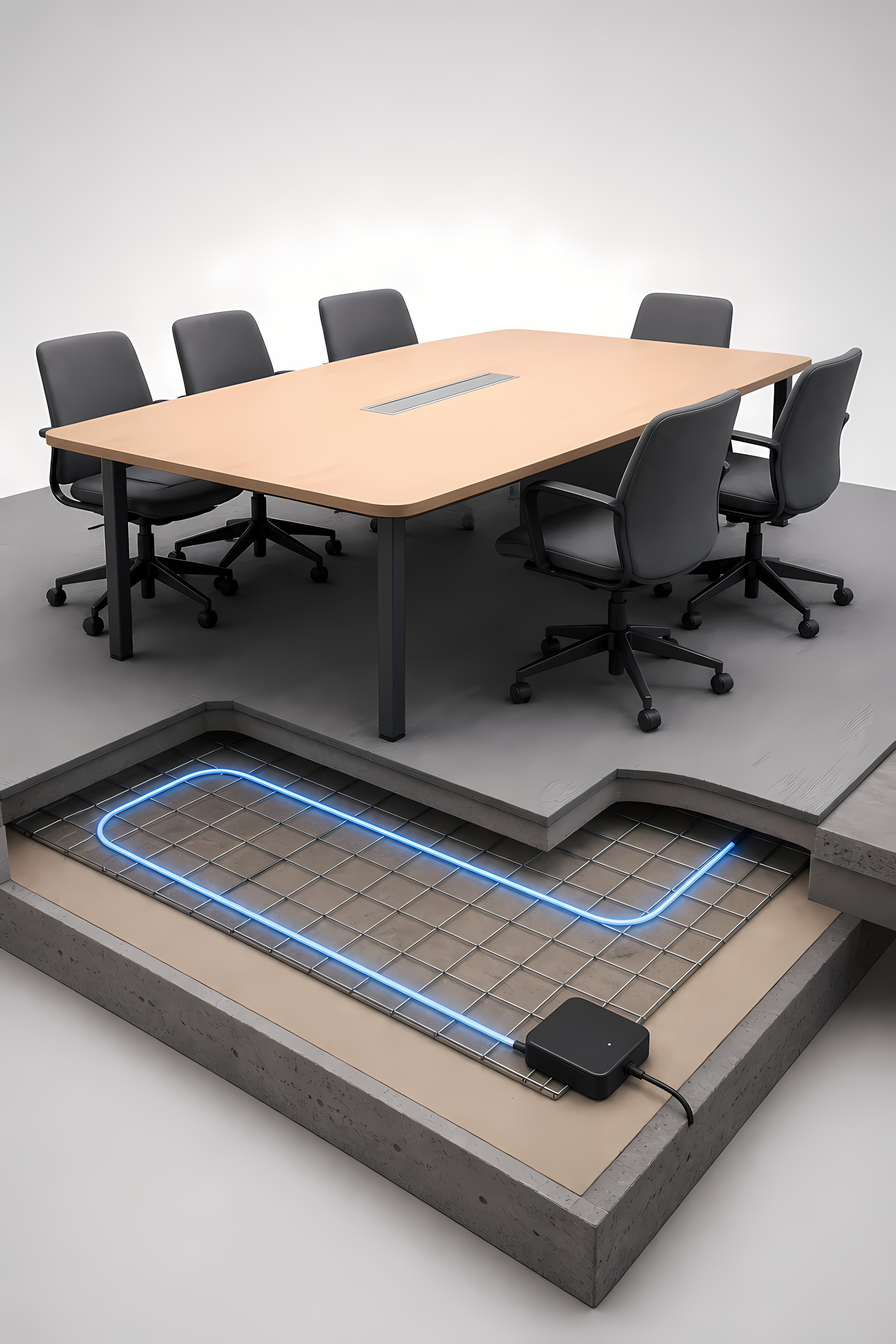
Hearing-loop performance can be affected by room geometry, reinforcement steel, structural metal, raised floors, electrical equipment, neighbouring loop systems, seating layout and the final installation height.

These conditions should be assessed during the design stage rather than discovered after flooring, joinery, ceilings or room finishes have been completed.

Early coordination between the AV integrator, electrical contractor, communications contractor, architect, builder, access consultant and certifier helps reduce rework and improves the likelihood of achieving consistent hearing-loop coverage.
  • Review floor construction and reinforcement steel.
  • Measure background electromagnetic noise.
  • Confirm the required listening and seating areas.
  • Coordinate loop cable routes before finishes are installed.
  • Plan DSP, amplifier, rack, power and network requirements.
  • Define testing, documentation and handover requirements.
Professional hearing loop installation showing coordinated cable installation and accessible audio system planning
Coordinate the installation before room finishes Loop cable pathways, structural metal, flooring, DSP feeds, equipment racks and electrical services can all affect the final system performance.
PHASE 01

Site survey

Review the room, floor construction, amplification system, adjacent spaces, structural metal and existing electromagnetic interference.

PHASE 02

System design

Define the hearing augmentation technology, coverage area, loop arrangement, amplifier, DSP routing, cable pathway, signage and controls.

PHASE 03

Coordinated installation

Coordinate loop cable, flooring, containment, rack equipment, audio interfaces, power, communications cabling and builder requirements.

PHASE 04

Testing and commissioning

Measure field strength, frequency response, magnetic background noise and coverage using appropriate calibrated testing equipment.

Testing by ear is not sufficient. A professional commissioning process should include objective measurements across the nominated listening area, documented test positions, system settings, coverage results and any identified limitations.
Integrated Accessible AV

Hearing augmentation should receive the right audio—not simply every sound.

The assistive listening feed should be deliberately designed into the complete AV signal flow, with appropriate source selection, level control, processing and monitoring.

Q

DSP and Q-SYS integration

A DSP can create a dedicated hearing-assistance mix, manage levels, route selected microphones and exclude unsuitable sources.

Q-SYS integration
D

Dante audio networking

Networked audio can distribute the hearing-assistance feed between rooms, DSPs, equipment racks and compatible assistive-listening transmitters.

Dante audio networking
VC

Video conferencing

Remote participant audio may need to be included with local microphones and presentation content without creating echo, feedback or double audio.

Meeting-room and corporate AV
PA

PA and presentation audio

Lectern microphones, wireless microphones, playback and presentation sources can be combined into a controlled accessible-audio mix.

Commercial audio systems

Emergency communication

Accessibility planning should consider how emergency information is communicated through audible, visual and other required warning methods—not only the day-to-day hearing loop.

Education communication systems

Monitoring and maintenance

System health, signal presence, receiver batteries, chargers, operating procedures and periodic performance tests require an ongoing support plan.

AV maintenance and support
Technology Partners and Resources

Hearing-loop and assistive-listening manufacturers

Masters Voice Technology can evaluate products as part of a complete system design rather than selecting equipment only from a product datasheet.

Manufacturer selection is only one part of the solution. The system must still be designed for the room, integrated with the AV platform, installed correctly, commissioned and supported through its operating life.
Frequently Asked Questions

Hearing loop regulations, compliance and installation FAQs

Practical answers for facility managers, builders, consultants, architects, schools, government agencies and building owners.

Is a hearing loop mandatory in Australia?
A hearing augmentation system may be required in particular rooms or spaces under the applicable National Construction Code provisions. Whether it is required depends on factors including the building classification, room use, inbuilt amplification system, construction approval and NCC edition applying to the project. The required system does not always have to be an induction loop; the project team should confirm the permitted solution and compliance pathway.
What Australian Standard applies to hearing loops?
AS 1428.5 addresses communication for people who are deaf or hearing impaired and includes assistive listening system considerations. IEC 60118-4 is an important performance standard for audio-frequency induction-loop systems. The project specification, certifier and access consultant should identify the standards and editions required for the project.
What percentage of a room must a hearing loop cover?
NCC provisions commonly nominate at least 80 percent of the floor area served by the inbuilt amplification system for an induction loop. Receiver-based systems generally have different coverage and receiver-quantity requirements. The applicable NCC edition and project documentation must be checked before design.
Does every hearing aid work with a hearing loop?
No. The hearing aid or cochlear implant requires an activated and correctly configured telecoil, commonly referred to as a T-coil. Some users may require a dedicated receiver and neck loop instead.
Can a hearing loop be retrofitted?
Often, yes. Retrofit feasibility depends on the floor, ceiling, joinery, cable pathways, metal construction, adjacent rooms, electromagnetic noise and existing AV system. A survey should be completed before selecting the loop type or amplifier.
What is the difference between a perimeter loop and a phased array?
A perimeter loop normally follows the boundary of the listening area. A phased-array or low-spill system uses multiple loop segments to improve field consistency and control spill. Phased arrays are often considered for complex construction, adjacent rooms or environments where privacy is important.
Can a hearing loop connect to Q-SYS or Dante?
Yes. A commercial DSP such as Q-SYS can create and manage the hearing-assistance mix. Dante or another networked-audio platform can transport that audio between equipment locations before it reaches a compatible loop driver or assistive-listening transmitter.
How is a hearing loop tested?
Commissioning normally includes objective measurement of magnetic background noise, field strength, frequency response and coverage at documented positions and heights. Results should be recorded in a commissioning report using appropriate calibrated equipment.
How often should a hearing loop be tested?
The facility should perform routine operational checks and schedule periodic professional testing according to its risk profile, maintenance plan, project documentation and applicable requirements. The system should also be checked after AV changes, renovations, flooring work or reported performance issues.
Does Auracast replace hearing loops?
Auracast is an important emerging broadcast-audio technology, but it should not automatically be assumed to replace a hearing loop or satisfy current regulatory requirements. Compatibility, receiver availability, signage, user access and the applicable compliance pathway must all be assessed.
Can Masters Voice integrate the system with the complete AV installation?
Masters Voice Technology can coordinate accessible audio with microphones, DSP, Q-SYS, Dante, presentation systems, video conferencing, PA systems, electrical services, communications cabling, commissioning and ongoing AV support across Sydney and New South Wales.
Plan an Accessible AV System

Design accessibility into the project—not around it later.

Masters Voice Technology can assist with room assessment, AV integration, hearing augmentation design coordination, electrical and communications infrastructure, installation, commissioning and ongoing support.

Sydney Greater NSW Government Education Commercial