Pubs Clubs Hotel AV
July 3, 2026
arrow up right

AV Guide for Pubs Clubs and Hotels

How to Design an AV System for a Pub, Hotel or Club

A successful hospitality venue is rarely one room with one purpose.

The main bar may need energetic background music and live sport. The dining area needs comfortable, evenly distributed sound. A rooftop or beer garden requires weather-resistant equipment and controlled coverage. Meanwhile, a function room may need microphones, presentations, DJs and private-event audio.

The right hospitality AV system brings these spaces together without forcing staff to operate complicated technical equipment.

This guide explains what venue owners and operators should consider when planning a professional AV system for a pub, hotel, club, restaurant, rooftop bar or function venue.

A good venue AV system should help the business operate

Venue AV is not simply a collection of televisions and speakers.

It is part of the customer experience and an important operational tool for the business.

A well-designed system can help a venue:

  • Create the right atmosphere in every trading area
  • Show different sporting events on different screens
  • Support private functions and corporate bookings
  • Provide reliable connections for DJs and entertainers
  • Promote food, drinks and upcoming events
  • Give staff straightforward control
  • Reduce technical interruptions during busy periods
  • Expand without replacing the entire system

The Sydney Park Hotel AV installation demonstrates this approach. Masters Voice Technology and ACCAV delivered zoned audio, rooftop AV, function-room technology, AV-over-IP distribution, commercial displays, microphones, local audio inputs, digital signage, data cabling and electrical integration throughout the venue.

Start with how the venue will be used

The best AV design begins with the venue’s operating requirements—not a product list.

Before choosing speakers, displays or amplifiers, define how each area will be used throughout the day.

A hospitality venue may include:

  • Main bar
  • Sports bar
  • Restaurant or dining area
  • Gaming room
  • Lounge
  • Rooftop
  • Beer garden
  • Function room
  • Dance floor
  • Entry or reception area
  • Private dining room
  • Stage or entertainment area

Each space may need a different source, volume, display layout and level of staff control.

For example, the dining room may require quiet background music while the main bar shows a major sporting event. At the same time, the function room may host a private presentation while the rooftop operates with a separate playlist.

A venue designed as one large audio zone cannot support these situations effectively.

1. Design the venue around independent AV zones

An AV zone is an area that can be controlled independently.

Depending on the design, each zone may have its own:

  • Music source
  • Volume
  • Television audio
  • Microphone routing
  • Operating schedule
  • Display content
  • Mute control
  • Event preset

A professionally designed zoned audio system allows the restaurant, bar, rooftop and function areas to operate independently while keeping everyday control simple for staff.

Why zoning matters

Without proper zoning, venues may experience:

  • Music being too loud in dining areas
  • Sports commentary playing in quiet spaces
  • Function-room audio interrupting the main bar
  • Outdoor speakers remaining active after closing
  • Staff walking between equipment racks to adjust volume
  • One faulty source affecting the complete venue

A properly zoned system gives the business flexibility without adding unnecessary complexity.

2. Match the audio design to each area

Different venue spaces require different loudspeaker strategies.

Main bars and sports areas

These areas often require:

  • Higher sound output
  • Clear television commentary
  • Strong music reproduction
  • Even coverage during busy periods
  • Enough headroom to prevent distortion

The goal is not simply maximum volume. The system should maintain energy and clarity even when the venue is full.

Dining areas

Restaurants and dining spaces usually benefit from:

  • Even background music
  • Wide loudspeaker coverage
  • Fewer obvious loud and quiet areas
  • Clear sound at comfortable levels
  • Independent volume control

Poorly positioned speakers often create tables that are too loud while other areas can barely hear the music.

Rooftops and beer gardens

Outdoor areas require careful consideration of:

  • Weather resistance
  • Speaker direction
  • Nearby properties
  • Venue boundaries
  • Wind and ambient noise
  • Local noise requirements
  • Secure mounting
  • Outdoor-rated cabling and connections

The AUDAC VIRO5 used in the Sydney Park Hotel system is an example of a compact loudspeaker that can suit hospitality environments requiring strong music and speech performance from a relatively discreet enclosure.

Function rooms

A function room may need to support:

  • Background music
  • Wireless microphones
  • Speeches
  • Presentations
  • Laptop audio
  • DJs
  • Live entertainment
  • Private television viewing
  • Corporate events

The room should be capable of operating independently from the rest of the venue.

Speaker options for hospitality venues

There is no single loudspeaker that is right for every part of a pub, hotel or club.

AUDAC VIRO5

The AUDAC VIRO5 is suited to hospitality areas requiring compact, high-quality music and speech reproduction.

Typical applications include:

  • Bars
  • Dining spaces
  • Lounges
  • Covered outdoor areas
  • Function rooms
  • Rooftops using the appropriate weather-resistant version

Its main strengths include:

  • Compact enclosure
  • Wide coverage
  • Strong music and speech performance
  • Black and white finishes
  • Suitability for visually sensitive spaces

AUDAC ATEO Series

The AUDAC ATEO range can be a strong option where clean architectural appearance and straightforward mounting are priorities.

Typical applications include:

  • Restaurants
  • Hotel lounges
  • Bars
  • Courtyards
  • Covered terraces

The ATEO range may be suitable where moderate background or foreground music is required and the loudspeaker needs to blend into the surrounding interior.

JBL Control Series

JBL Control loudspeakers are commonly considered for commercial background and foreground audio.

Typical applications include:

  • Pubs
  • Restaurants
  • Outdoor dining areas
  • Function rooms
  • General hospitality spaces

Potential advantages include:

  • Broad product range
  • Indoor and weather-resistant models
  • Multiple sizes and output levels
  • Familiar commercial-audio platform

Bose DesignMax and FreeSpace

Bose commercial loudspeakers may suit venues that prioritise discreet appearance and consistent background-music coverage.

Typical applications include:

  • Dining rooms
  • Hotel foyers
  • Lounge areas
  • Private dining spaces
  • Architecturally finished interiors

What matters more than the brand

The result depends heavily on:

  • Speaker placement
  • Coverage angle
  • Mounting height
  • Amplifier selection
  • DSP configuration
  • Subwoofer integration
  • Room acoustics
  • Final commissioning

A premium loudspeaker installed in the wrong location can perform worse than a more economical model that has been properly designed and tuned.

3. Design live sport viewing as a complete system

Live sport can be a major revenue driver for pubs, hotels and clubs.

A strong sports-bar system should make it easy to:

  • Show different games on different screens
  • Send one event to every display
  • Match the correct audio to the selected screen
  • Switch quickly between Foxtel, free-to-air and streaming sources
  • Prioritise major sporting events
  • Control displays from a central interface
  • Avoid staff handling multiple remote controls

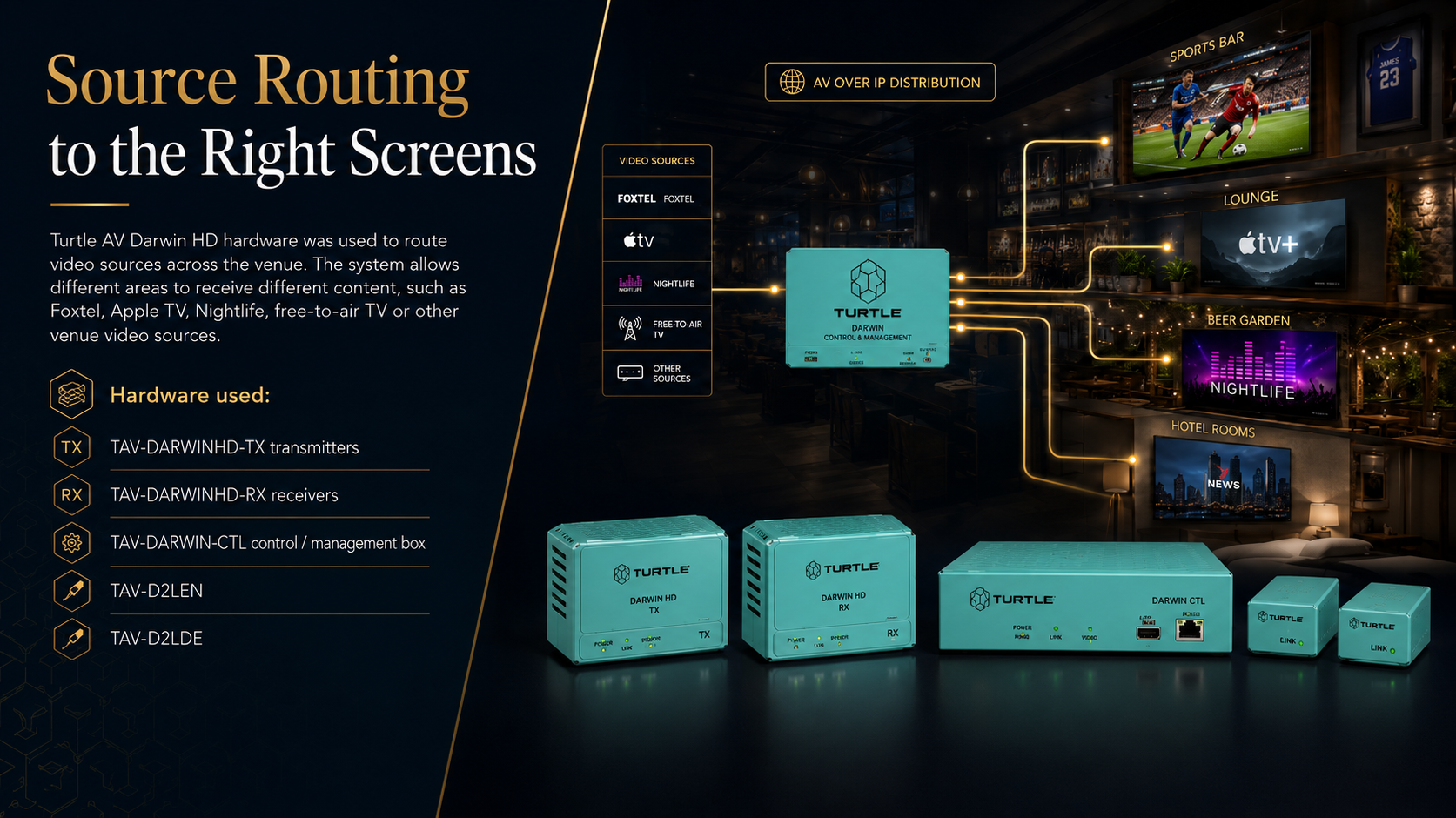
At Sydney Park Hotel, networked video distribution allows sources such as Foxtel, Apple TV, Nightlife, free-to-air television and local video inputs to be routed to different areas of the venue.

Screen positioning matters

Displays should be selected and positioned according to:

  • Viewing distance
  • Room size
  • Seating direction
  • Glare
  • Mounting height
  • Sightlines
  • Number of simultaneous sporting events
  • Digital-signage requirements

One oversized display placed too high or behind structural columns may be less effective than several correctly positioned commercial screens.

4. AV over IP or a traditional HDMI matrix?

The video-distribution system determines how content travels from sources to displays.

There are two common approaches.

Traditional HDMI matrix

A central HDMI matrix connects a fixed number of sources to a fixed number of displays.

Advantages

  • Suitable for smaller systems
  • Straightforward architecture
  • Predictable configuration
  • May cost less for a limited installation

Limitations

  • Fixed input and output capacity
  • Expansion may require matrix replacement
  • Long-distance HDMI requires extension hardware
  • Central cabling can become complicated
  • Less flexible across large or multi-level venues

AV over IP

AV over IP converts video sources into network streams that can be routed to decoders at each display.

Advantages

  • Easier to expand
  • Flexible source-to-screen routing
  • Suitable for large or multi-level venues
  • Uses structured network cabling
  • New endpoints can be added as the venue grows
  • Supports centralised staff control
  • Well suited to multiple screens and sources

Considerations

  • Requires a correctly designed network
  • Managed-switch selection and configuration are critical
  • Network bandwidth and multicast traffic must be planned
  • Product selection should consider latency and image quality
  • Ongoing technical support may be required

The Sydney Park Hotel project used Turtle AV Darwin HD encoders, decoders and network infrastructure to distribute content throughout the venue.

Video distribution comparison

Consideration HDMI matrix AV over IP
Best suited to Smaller fixed installations Larger or expanding venues
Expansion Limited by matrix size Add endpoints as required
Cabling HDMI and extension hardware Structured network cabling
Multi-level venues Can become complex Well suited
Routing flexibility Fixed input and output structure Highly flexible
Network dependency Low High
Future changes May require matrix replacement Usually easier to accommodate

AV-over-IP product options

Turtle AV Darwin HD

Darwin HD is a suitable option for venues requiring flexible video routing without moving into the highest-cost enterprise tier.

Potential venue applications:

  • Sports bars
  • Pubs with multiple screens
  • Function rooms
  • Digital signage
  • Entertainment areas
  • Multi-level hospitality venues

Why it suited Sydney Park Hotel:

  • Multiple video sources
  • Different content across separate zones
  • Expandable endpoint structure
  • Integration with venue control and networking

Q-SYS NV Series

Q-SYS NV endpoints are suitable where video distribution, control and audio processing are being built within the wider Q-SYS platform.

Q-SYS states that its NV Series provides low-latency network video distribution, software-defined endpoints and integration without separate management or control hardware.

Consider Q-SYS NV when:

  • The venue already uses Q-SYS
  • Audio, video and control need to be unified
  • Custom touch-panel operation is required
  • The system includes function rooms or conferencing
  • Central monitoring is a priority

Crestron DM NVX

Crestron DM NVX is generally positioned for high-performance, enterprise-grade AV-over-IP systems.

Consider DM NVX when:

  • The project has a larger commercial budget
  • Advanced control integration is required
  • Video quality and enterprise scalability are priorities
  • The venue is part of a larger hotel, stadium or premium entertainment precinct

Extron NAV

Extron NAV may suit projects requiring an established enterprise control and AV-distribution ecosystem.

Consider Extron NAV when:

  • Extron control is already being used
  • The project requires consistent enterprise standards
  • Strong system management and support are priorities

Which platform is best?

The correct product depends on:

  • Number of sources
  • Number of displays
  • Required resolution
  • Acceptable latency
  • Network capability
  • Control platform
  • Expansion plans
  • Budget
  • Support model

The lowest hardware price is not always the lowest long-term cost. A poorly selected system may be difficult to expand or support.

5. Use commercial displays—not domestic televisions

Domestic televisions may appear cheaper, but they are not always the right choice for a venue operating for long hours.

Commercial displays can offer:

  • Longer operating schedules
  • Commercial warranties
  • Central monitoring
  • Remote control
  • Secure menu configuration
  • Consistent model availability
  • Digital-signage support
  • Better installation and management options

Sydney Park Hotel uses LG 55-inch and 65-inch commercial displays for live sport, venue content, signage and distributed video.

LG promotes commercial television platforms with customisation and remote-diagnostic capabilities, while its hospitality signage range supports information and promotional content.

Samsung also offers commercial and hospitality displays with central management, customised menus and commercial warranty options.

Commercial display comparison

Option Best suited to Key consideration
LG commercial displays Sport, signage and general venue use Strong commercial and hospitality range
Samsung commercial displays Hospitality TV and digital signage Central management and customised menus
Sony professional displays Premium image quality and signage Often selected for high-end presentation
Domestic television Small, low-use applications Warranty and management limitations may apply

A venue should also consider brightness, reflection, viewing angle and operating hours rather than selecting screens by size alone.

6. Make the system easy for staff

The best system is one that staff can operate confidently during a busy Friday night.

A simple venue interface may allow staff to:

  1. Choose a venue area
  2. Select the music or television source
  3. Adjust the permitted volume range
  4. Choose which content appears on each screen
  5. Activate function or event presets
  6. Turn selected areas on or off

Staff should not need to understand:

  • HDMI routing
  • Network switches
  • DSP signal flow
  • Amplifier channels
  • Encoder addresses
  • Speaker impedance
  • Equipment-rack patching

The Sydney Park Hotel system was designed so staff could control audio sources, screen content, microphones, rooftop modes, function settings and signage without operating the underlying technical hardware.

Useful venue presets

A well-designed control system may include:

  • Normal trading
  • Lunch service
  • Dinner service
  • Live sport
  • Major sporting event
  • Private function
  • DJ mode
  • Rooftop event
  • Background music only
  • Closing mode

Presets reduce the number of decisions staff need to make and help prevent incorrect system settings.

7. Provide local inputs where they are needed

Hospitality venues often host DJs, presenters, entertainers and private events.

Running temporary cables back to the main AV rack is inconvenient and can create safety or reliability problems.

Useful local connections may include:

  • Bluetooth audio
  • 3.5 mm input
  • Stereo RCA
  • USB-C presentation input
  • HDMI
  • DJ input plate
  • Microphone input
  • Network audio
  • Wireless microphone receiver

Sydney Park Hotel includes Australian Monitor Bluetooth wall plates, DJ inputs, local audio connections and wireless microphone inputs to support different venue uses.

Bluetooth versus fixed professional inputs

Bluetooth is convenient for everyday background music, but it should not always be the only connection method.

Connection Best suited to Main consideration
Bluetooth Casual music playback Pairing and range limitations
3.5 mm or RCA Simple local audio Consumer-style connection
Balanced analogue input DJs and professional sources Correct input levels are required
Dante audio Larger integrated systems Requires professional network design
HDMI or USB-C Function presentations Adapter compatibility should be planned

For important functions, a wired professional connection is generally more dependable than relying solely on Bluetooth.

8. Choose the right audio processor

The audio DSP controls how sound moves through the venue.

It can manage:

  • Source routing
  • Zone volume
  • Equalisation
  • Speaker processing
  • Microphone levels
  • Ducking
  • Limiters
  • Presets
  • Delays
  • Subwoofer integration
  • Staff control permissions

Sydney Park Hotel uses a BSS BLU-100 DSP with Lab Gruppen amplification to support its zoned audio system.

BSS Soundweb

BSS Soundweb is suitable for fixed commercial audio systems requiring flexible signal processing and control integration.

Good for:

  • Zoned venue audio
  • Bars and clubs
  • Function rooms
  • Background music
  • Multiple analogue audio sources

Q-SYS

Q-SYS combines DSP, control, network audio, user interfaces and monitoring.

Good for:

  • Larger venues
  • Highly customised touchscreens
  • Audio and video integration
  • Multi-room control
  • Remote management
  • Future expansion

Biamp Tesira

Biamp Tesira provides scalable networked DSP and fixed-I/O processor options through products such as TesiraFORTÉ.

Good for:

  • Function venues
  • Conference and event spaces
  • High-quality microphone processing
  • Larger networked-audio designs

Symetrix

Symetrix DSP platforms can suit hospitality venues requiring flexible zoning, control and audio processing.

Good for:

  • Restaurants
  • Bars
  • Clubs
  • Multi-zone background music
  • Custom control panels

The best DSP is the one that matches the venue’s complexity, support requirements and future plans.

9. Plan digital signage as part of the system

Displays do not need to show television all day.

They can also promote:

  • Daily specials
  • Upcoming entertainment
  • Membership offers
  • Food and beverage promotions
  • Function-room branding
  • Sponsor content
  • Welcome messages
  • Event schedules
  • Venue directions
  • Responsible-service messaging

Commercial displays can switch between live television and signage content depending on the time or event.

LG specifically positions its hospitality displays for information and advertising content, while Samsung offers hospitality signage and content-management options.

A good design should establish whether signage content will be:

  • Locally stored
  • Cloud managed
  • Scheduled
  • Controlled by venue staff
  • Managed by a marketing provider
  • Shared across multiple locations

10. Do not overlook the network, electrical and cabling design

Modern venue AV depends heavily on infrastructure.

A stable system may require:

  • Managed network switches
  • PoE capacity
  • VLAN configuration
  • Structured data cabling
  • Dedicated power circuits
  • Surge protection
  • Rack ventilation
  • Correct equipment-room cooling
  • Secure display mounting
  • Outdoor-rated cable routes
  • Spare network capacity
  • Documented patching and labelling

AV over IP should not simply be connected to an unmanaged switch and expected to work reliably.

Network traffic, multicast configuration, bandwidth, PoE demand and future expansion all need to be considered.

Masters Voice Technology combines audio visual services, communications and data cabling and electrical services, allowing these parts of the project to be coordinated through one delivery team.

11. Plan for support after opening night

Hospitality systems often operate for long hours, and faults can directly affect customers, events and revenue.

Common venue AV support issues include:

  • A screen not receiving the selected source
  • Foxtel or streaming source failures
  • Amplifier protection faults
  • Bluetooth pairing problems
  • Wireless microphone issues
  • Network-switch faults
  • Staff changing incorrect settings
  • Damaged local input plates
  • Outdoor speaker failures
  • Content-routing problems

An ongoing support plan may include:

  • Remote diagnosis
  • Preventative maintenance
  • Firmware updates
  • System backups
  • Display checks
  • Amplifier and speaker testing
  • Staff retraining
  • Priority onsite response
  • Spare equipment planning
  • Event support

The Sydney Park Hotel solution includes ongoing AV support and maintenance as part of the complete venue technology approach.

Product comparison for a typical pub or hotel

System area Cost-conscious option Flexible commercial option Premium enterprise option
Video distribution Fixed HDMI matrix Turtle AV Darwin HD Q-SYS NV, Crestron DM NVX or Extron NAV
Audio DSP Commercial zone mixer BSS Soundweb or Symetrix Q-SYS or Biamp Tesira
Indoor speakers TOA commercial speakers AUDAC ATEO or VIRO Bose DesignMax or premium JBL
Outdoor speakers Weather-resistant commercial cabinets AUDAC weather-resistant range Premium high-output architectural system
Displays Entry commercial display LG or Samsung commercial range Premium professional display or LED
Staff control Wall volume controls Custom touchscreen or web interface Fully integrated venue control
Local audio Bluetooth and analogue plate Professional DJ and microphone inputs Dante and advanced event routing

These categories are starting points. Final product selection should follow a site survey, system design and operational review.

Questions to ask before requesting a venue AV quote

A prospective buyer should be ready to discuss:

  1. How many independent venue zones are required?
  2. Which spaces need background music?
  3. Which areas need television audio?
  4. How many screens will be installed?
  5. How many different sporting events need to be shown at once?
  6. Are Foxtel, free-to-air and streaming sources required?
  7. Does the venue have a rooftop or outdoor area?
  8. Are there neighbouring noise-sensitive properties?
  9. Will the venue host private functions?
  10. Are wireless microphones required?
  11. Will DJs or live performers connect to the system?
  12. Is digital signage required?
  13. Who will control the system?
  14. Is remote support required?
  15. Will more screens or zones be added later?

These questions help determine whether the venue needs a simple fixed installation or a scalable networked AV platform.

Why professional venue AV design matters

A hospitality venue changes throughout the day.

Breakfast, lunch, sport, dining, live entertainment and private functions may all place different demands on the same building.

A professionally designed system allows the technology to adapt without requiring staff to rebuild the setup for every event.

The strongest venue AV systems deliver:

  • The right atmosphere in every area
  • Clear, controlled audio
  • Flexible live-sport distribution
  • Straightforward staff operation
  • Reliable event connections
  • Commercial-grade equipment
  • Scalable infrastructure
  • Ongoing technical support

Good AV should not become the centre of attention.

It should make the venue feel better, operate more smoothly and help customers stay longer.

See a real multi-zone venue AV system

Masters Voice Technology and ACCAV designed and delivered a complete multi-level system for Sydney Park Hotel, including:

  • Zoned venue audio
  • Rooftop AV
  • Function-room technology
  • AV-over-IP distribution
  • LG commercial displays
  • Wireless microphones
  • Bluetooth and DJ inputs
  • Digital signage
  • Control systems
  • Network upgrades
  • Electrical integration
  • Ongoing support

View the Sydney Park Hotel AV installation case study.

You can also explore:

Whether you are opening a new venue, renovating an existing hotel or replacing an unreliable system, Masters Voice Technology can assess your requirements and recommend a practical upgrade pathway.

Thank you! Your submission has been received!
Oops! Something went wrong while submitting the form.
Ready to talk about your project?