
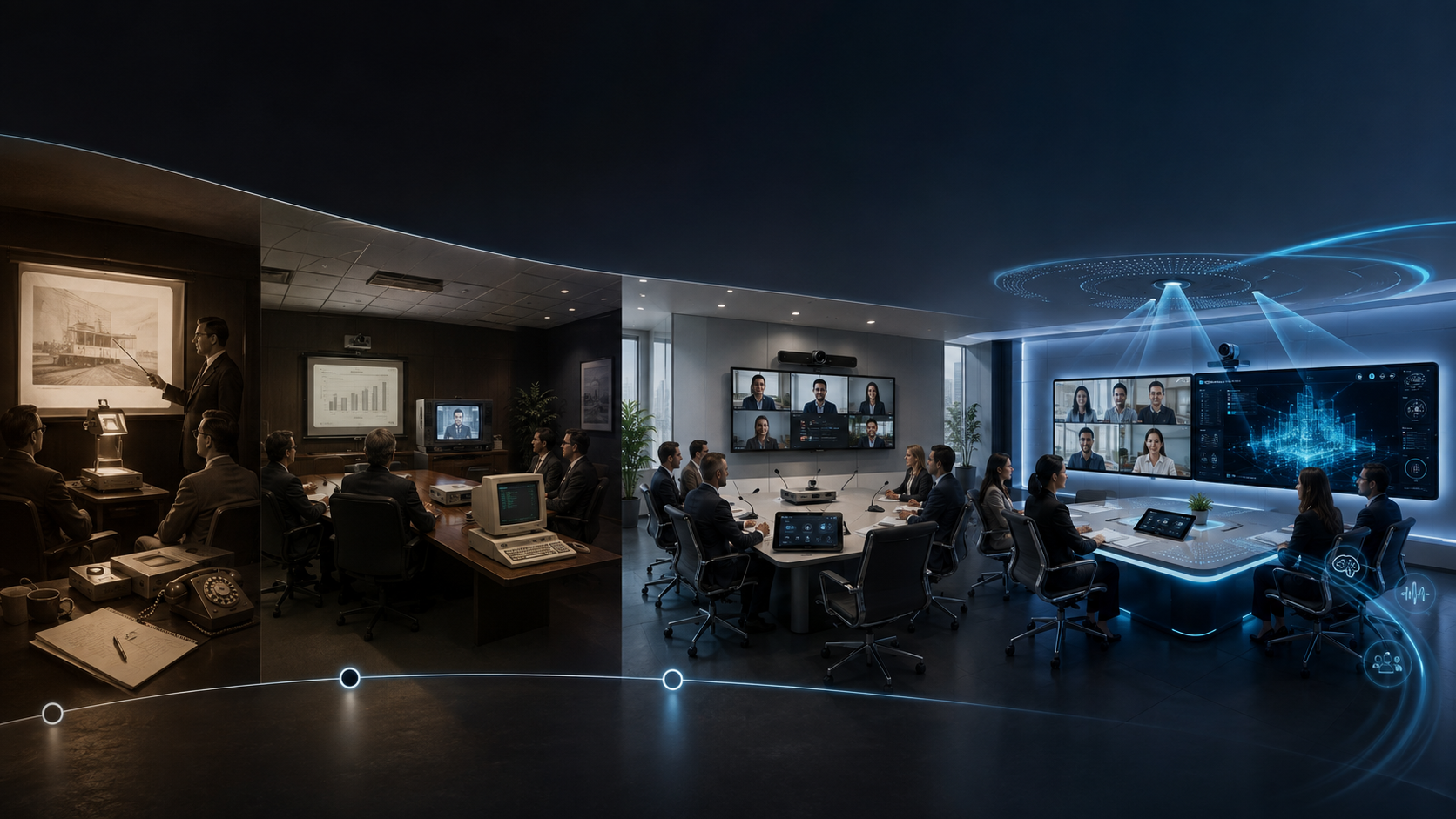

Today's meeting room can automatically frame a presenter, determine who is speaking, remove background noise, share content wirelessly and connect participants around the world.
Workplace collaboration once centred on blackboards, telephones, printed documents and physical presentation material. Each generation of AV removed another barrier—first helping people present information, then share media, then meet across locations, and now allowing rooms to respond intelligently to the people inside them.
Workplace meetings were predominantly analogue. Presentations relied on printed documents, chalkboards, film projectors and photographic slides.
Larger meeting and training rooms could also include wired microphones, valve or early transistor amplifiers and wall-mounted loudspeakers.
Overhead projectors became increasingly common in offices, education and training environments. Presenters could write or print information onto transparent sheets and project it directly onto a screen.
This made it practical to annotate diagrams, highlight financial information and reveal content progressively during a meeting.
CRT displays and videotape expanded the range of media that businesses could use for training, internal communications and presentations.
Television monitors became more common in boardrooms and training facilities.
Organisations could record training material and company messages rather than relying entirely on film.
Personal computers transformed how business information was created. Spreadsheets, word processors and early presentation software increasingly replaced paper-based workflows.
Early computer-compatible projection and large CRT displays began to appear, while digital compression and ISDN helped dedicated business video conferencing develop.
Computer presentations increasingly replaced overhead transparencies.
Data projectors made laptop-based presentations increasingly practical.
Dedicated rooms connected offices nationally and internationally.
Control systems began combining room functions into one interface.
The transition from analogue to digital changed both meeting-room performance and system engineering.
DVI and later HDMI enabled high-resolution digital signals between computers, switchers and displays.
LCD and plasma panels increasingly replaced large CRT monitors.
DSP introduced AEC, automixing, EQ, routing and programmable audio processing.
Crestron, AMX and Extron systems simplified sophisticated rooms through one interface.
Fast broadband, cloud computing, smartphones and powerful laptops fundamentally changed workplace collaboration.
Skype for Business, Microsoft Teams, Zoom, Cisco Webex and Google Meet moved video collaboration from proprietary conferencing networks toward software and cloud services.
Video meetings changed from an occasional corporate activity into a normal part of everyday working life.
Automatic participant and speaker framing.
Ceiling microphones provide more consistent room coverage.
Scheduled meetings can start directly from the room.
Rooms can increasingly be monitored and managed remotely.
Increasingly, room capability is determined as much by software, cloud services and AI as by the hardware installed.
Automatic framing, presenter tracking and multi-camera views.
Beamforming, AEC, automixing and advanced noise processing.
Transcription, summaries and meeting intelligence.
Dante, AES67, AV-over-IP and PoE integrate AV with IT networks.
A contemporary room combines displays, cameras, microphones, DSP, collaboration platforms, networks, control and cloud management into one predictable user experience.
For most of AV history, systems reacted to instructions. Increasingly, microphone arrays can determine where speech is originating, cameras can identify the active speaker, and collaboration software can transcribe speech and organise meeting information into summaries and actions.
Modern workplace AV is no longer designed by simply selecting a television, camera and microphone.
Room size, acoustics, viewing distance, microphone coverage, camera positioning, lighting, network architecture, collaboration platforms, control, cybersecurity and ongoing support all influence the result.
Masters Voice Technology designs and integrates workplace environments ranging from smaller collaboration rooms and Microsoft Teams Rooms through to executive boardrooms, training spaces and sophisticated networked AV systems.
Business video conferencing became increasingly practical during the 1980s and 1990s as digital compression and telecommunications infrastructure improved.
Computer-based presentations expanded rapidly during the 1990s as laptops and data projectors became increasingly practical for business meeting environments.
Cloud collaboration, USB conferencing, wireless presentation, BYOD systems and networked technologies such as Dante and AV-over-IP changed both the user experience and the underlying architecture.
An intelligent meeting room combines cameras, microphones, audio processing, room control and collaboration software that can automate framing, speaker detection, meeting joining, transcription and system management.